
1.3.2 Critical reflection

Critical reflection on children’s learning and development, both as individuals and in groups, drives program planning and implementation.

We need to identify what it is we are reflecting upon before proceeding. The element says critical reflection drives the program, but what exactly is a program. We need to interchange the word program with curriculum and use the description in the EYLF.

Curriculum:
in the early childhood setting curriculum means ‘all the interactions, experiences, activities, routines and events, planned and unplanned, that occur in an environment designed to foster children’s learning and development’.

EYLF Page 9

Let’s pull this apart into individual words and add the critical reflection to see what we need to do to drive the program’s planning and implementation.

  • Critically reflect upon our interactions to drive program planning and implementation
  • Critically reflect upon experiences, to drive program planning and implementation
  • Critically reflect upon activities, to drive program planning and implementation
  • Critically reflect upon routines to drive program planning and implementation
  • Critically reflect upon planned events to drive program planning and implementation
  • Critically reflect upon unplanned events to drive program planning and implementation
  • Critically reflect upon our environment to drive program planning and implementation   

 What is a critical reflection?

The good news is most people are reflecting most of the time. You probably never write down all your reflections or thoughts about what you do as a critical reflection or know it is a reflective process.

The EYLF says ‘Critical reflection involves closely examining all aspects of events and experiences from different perspectives. Educators often frame their reflective practice within a set of overarching questions, developing more specific questions for particular areas of enquiry.’

To create a ‘different perspective’ we need to imagine ourselves looking at things through different people’s eyes.

What do you see if you look from a child’s perspective (critical reflection) and how has that driven program planning and implementation?

What do you see if you look from a parent’s perspective (critical reflection) and how has that driven program planning and implementation?

What do you see if you look from another educator’s perspective (critical reflection) and how has that driven program planning and implementation?

What do you see if you look from a child’s perspective (critical reflection) and how has that driven program planning and implementation?

Critically reflect upon our interactions from a child’s perspective. What do you see?

___________________________________________________________

How has this driven program planning and implementation? 

___________________________________________________________

What do you see if you look from a parent’s perspective (critical reflection) and how has that driven program planning and implementation?

 Critically reflect upon our unplanned events from a parent’s perspective. What do you see?

________________________________________________________________

How has this driven program planning and implementation? 

________________________________________________________________

Exceeding Theme Core
All educators regularly engage in planned and spontaneous critical reflection on children’s learning and development, as individuals and in groups, and make identified changes to the design and implementation of the program. Critical reflection includes social justice and equity considerations, theoretical and philosophical influence, and how well all educators include the views and input of children, families and the community.

Where is your practice compared to the above statement?

____________________________________________________
____________________________________________________

____________________________________________________
____________________________________________________
____________________________________________________
____________________________________________________
____________________________________________________

1.2.3 Child directed learning

Each child’s agency is promoted, enabling them to make choices and decisions that influence events and their world

Go through the checklist and be honest so your Educational Leader and Nominated Supervisor know how to help you be the best.

E = Embedded, yes, I do that ALL the time.
K = We know we need to do that, but we don’t do
it all the time.
T = Please teach me how to do it or improve my understanding of why we need to do it.

Child Directed Learning Edu 1
Do you arrange play experiences, routines and the physical environment so children have a range of opportunities to make choices about what they will do and how they will do it? Can you see this in the curriculum?
Do you encourage children to make choices and decisions? Does the curriculum show this?
Do you acknowledge children as capable and competent, and encouraging them to act autonomously? Does the curriculum show this?
Do you provide children with strategies to make informed choices about their behaviours? Does the curriculum show this?
Do you incorporate children’s ideas and suggestions in planning? Does the curriculum show this?
Do you provide encouragement and display enthusiasm for children’s attempts to gain new skills and knowledge? Does the curriculum show this?
Do you embrace, and support play experiences initiated by children, motivating children to persist and extend their learning? Does the curriculum show this?
Do you notice and listen carefully to children’s concerns and discuss diverse perspectives on issues of inclusion and exclusion, and unfair behaviour? Does the curriculum show this?
Do you encourage children to direct their own play and leisure experiences with their peers? Does the curriculum show this?
Does the curriculum show children openly expressing their feelings and ideas in their interactions with others?
Does the curriculum show children initiating play?
Does the curriculum show children beginning to display understanding and willingness to negotiate and share with others?
Does the curriculum show children showing leadership, making decisions and following directions given by other children?
Does the curriculum show children actively participating in decisions that affect them, including their learning and leisure/rest?
Does the curriculum show children being supported to assess and manage risk?

This element is connected directly to children having the right to provisions, protection and participation under the United Nation’s Rights of the Child. For example:

Article 12
Children have the right to say what they think should happen when adults are making decisions that affect them, and to have their opinions taken into account.

Article 29
Your education should help children use and develop their talents and abilities. It should help children learn to live peacefully, protect the environment and respect other people.

Article 31
Children have the right to play and rest.

Let’s look at Babies – Milo’s first day 8 weeks old

This morning Tommy’s Turtles welcomed Milo into the room for his first big day. Milo has been forming relationships with his educators by looking and smiling at them. Milo used non-verbal cues and cuddled in to his educators. Throughout the day the Nursery staff have been acknowledging and responding to Milo’s cues and signals and following his home routine. When Milo showed signs of distress and agitation he was communicating his needs, which Natasha, Karen and Haley were able to meet with a cuddle, a bottle or sleep.  Milo showed how he could freely express his emotions and be involved in meaningful interactions with his educators to have his needs met and have control of his word.

Natasha, Karen and Haley are looking forward to spending more time with Milo throughout the week as we work to further build a bond with Milo and his family.

See how Natasha, Karen and Haley are meeting the outcome 1.2.3 Child directed learning – each child’s agency is promoted, enabling them to make choices and decisions that influence events and their world. When working with babies we need to be tuned into their signals so we can meet their needs. If not the baby will tend to cry.

Imagine
Xavier and Bryleigh have been confidently sharing the formula tins this morning as they used their imaginations to explore their environment. Xavier first sourced three tins from the recycled basket before Bryleigh arrived. Haley was sitting with Xavier, asking “what can we do with these Xavier?” Xavier began stacking the tins on top of one another to create a tower. As Xavier stacked the tins, he explored a new challenge and discovery, finding that stacking the tins wasn’t as easy as it seemed. Xavier placed a tin on top of one before stacking another, using both hands to ensure stability. During this process, Haley displayed her delight, encouragement and enthusiasm for Xavier’s attempts and successes as he showed his determination and persistence.

Bryleigh arrived later to see the tins lying on the floor before she crawled towards them. Using her own imagination and expressing her creativity through play, Bryleigh used the palm of her hand to hit the top of the tin, creating a musical sound. “Oh, you’re using the tins as drums” explained Haley. “Xavier was just using the same tins to stack”. Xavier approached Haley and Bryleigh in order to contribute to the experience Bryleigh had initiated.

Providing Xavier and Bryleigh with a wider range of flexible and open-ended experiences within their environment will allow them both to further build on their imagination skills. Perhaps we could source some loose parts from our homes to explore with?
Haley

Exceeding Theme Core

All educators consistently and respectfully support children to make choices and decisions throughout the day, and incorporate children’s ideas and views into the program to promote and extend learning. All educators regularly reflect, individually and with each other, on how they ensure the agency of every child at the service.

Where is your practice compared to the above statement?

__________________________________________________
__________________________________________________
__________________________________________________
__________________________________________________
__________________________________________________
__________________________________________________
__________________________________________________
__________________________________________________


1.2.2 Responsive teaching and scaffolding

Educators respond to children’s ideas and play and extend children’s learning through open-ended questions, interactions and feedback.

Go through the checklist and be honest so your Educational Leader and Nominated Supervisor know how to help you be the best.

E = Embedded, yes, I do that ALL the time.
K = We know we need to do that, but we don’t do
it all the time.
T = Please teach me how to do it or improve my understanding of why we need to do it.

Teaching Practices Edu 1
Do you let children lead the development of the curriculum?
Are you flexible in planning the curriculum ie don’t plan weeks or months in advance or have pre-determined themes?
Do you follow children’s learning preferences eg don’t force children to be involved in groups or activities (like formal structured group times) that don’t interest them
Are you flexible when it comes to routines where possible, giving children long periods of unhurried time?
Do you use intentional teaching practices whenever opportunities arise, including during routines, not just at set times like group time?
Do you reflect critically on activities, children’s learning and your teaching practices, looking at events from the viewpoint of children, families, colleagues and the community?
Do you change your practices as a result of your critical reflections?
Do you have conversations with children of all ages to affirm their identity and their place in their community?
Do you promote activities which encourage children to interact and learn for each other?
Do you identify what each child knows, can do and understands?
Do you extend each child’s learning based on what they know, can do and understand?
Does your documentation clearly show what children know and what you have done to extend learning?
Can families understand the documentation?
Do you participate in children’s imaginary play while allowing children to direct the drama?
Do you act on opportunities to have sustained interactions and conversations with a child or children eg while changing nappies, during meals, during play?
Do you base learning around relationships that you have with children, and that they have with their families and community, rather than relying on resources and equipment?
Do you actively seek to find out more about children’s everyday lives eg through conversations with their families?
Do you use information gained about children from their families and enrolment information to plan the Curriculum?
Do you include room routines as opportunities for learning?
Do you make sure your own beliefs and values about what children can do don’t limit their learning opportunities?

Case Study – Farm Animal Wall
Karen placed different farm animals on the wall before inviting the children over to explore relationships with living things. “These animals live on a farm” Karen explained. As the children pointed to the different animals Karen named them. “This is a sheep, dog, a pig, a cow, a horse, a chicken and a duck”. The children watched and listened as Karen continued to discuss the different features and colours of the animals. “There is a pink pig, a black and white cow and dog, a white duck and sheep, a brown chicken.

Karen modelled language and encouraged the children to express themselves through their own interpretation of language by pointing to the animals and making the sounds of each animal. “A cow goes moo, a dog goes woof, a sheep goes baa.” Karen repeated the sounds, so the children become familiar with which sound belonged to each animal.  cow and dog, a white duck and sheep, a brown chicken.
Karen modelled language and encouraged the children to express themselves through their own interpretation of language by pointing to the animals and making the sounds of each animal. “A cow goes moo, a dog goes woof, a sheep goes baa.” Karen repeated the sound’s, so the children become familiar with which sound belonged to each animal.
Learning Outcomes 2.4 & 5.1
Karen

Measurement

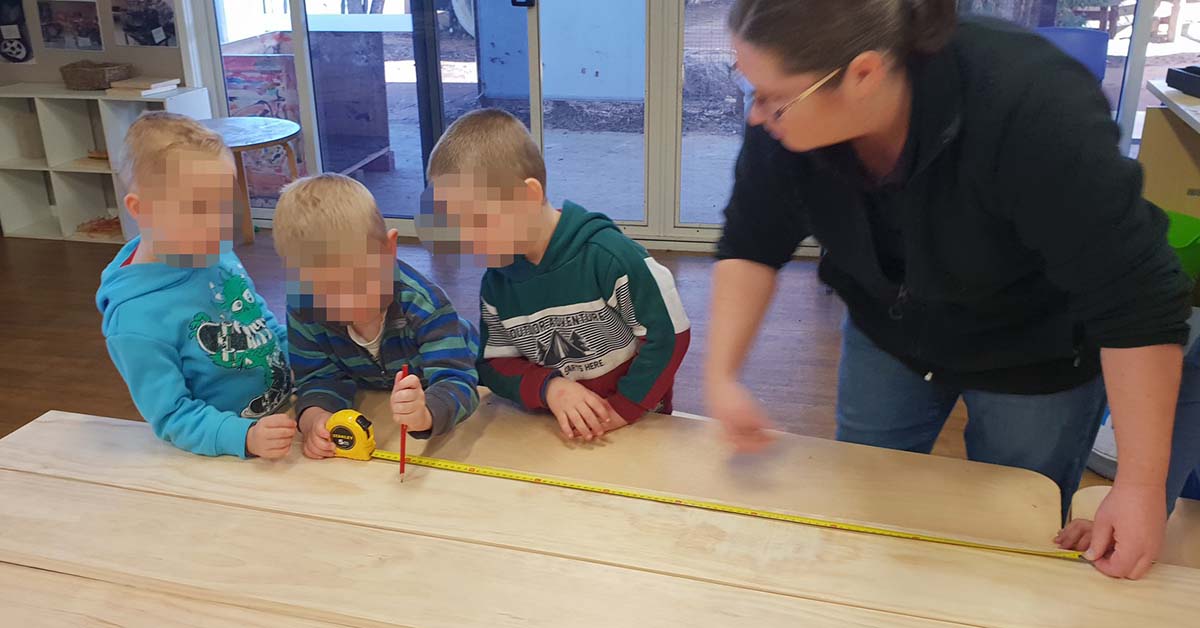
Continuing from yesterday, we discussed other forms of measurement. We used a tape measure to see the length of the table then we measured the width. Cherie told Jadzia, Churchill, Ivy, Eva, Zayne and Havana we would need to know these measurements if we were making or buying a tablecloth. Cherie said the size of the object we are measuring determines if we use a ruler or a tape measure. Zayne got a dinosaur to measure. Cherie questioned with, “Should we measure it with the small ruler or the long retractable tape measure?” Zayne said, “this ruler.” Jadzia loudly declared “No, this one,” handing the tape measure to Zayne. Ivy collected a skirting board that was in the room and Cherie asked what we should measure it with. Ivy picked the long retractable tape measure and stretched it out with the help of Nella. Cherie demonstrated how we look at the end of the object and notice what number it is next too. Cherie said each unit of length is given a number. Ivy softly replied “1,2 and 3. It’s 2.” Cherie recognised mathematical understandings that children bring to learning and builds on these in ways that are relevant to each child. Cherie praised Ivy’s knowledge and responded the units go up like counting. Ivy applies her mathematical knowledge to daily activities and makes predictions. LO 4.2 The children learnt how to stretch out a tape measure and know that units of measurement go up like counting. Eva stretched out the tape measure to the length of the dinosaur and looked up at Cherie saying “Five.”

Case Study –

Educator Jane was trying to run a group time and became very frustrated when the children jumped up and ran over to the window in their classroom as a huge truck with a digger appeared in the centre’s car park. Jane asked her team member for assistance by bringing the children back to the mat, so she could finish the book. Behaviour problems followed.

Exceeding Theme Core

All educators consistently and respectfully respond to each child’s ideas and play, for example through open-ended questions and feedback, to extend each child’s participation, learning and development. All educators consistently draw on families’ or communities’ understanding of each child’s strengths, ideas, culture and interests to extend their learning and development, and regularly reflect, individually and with each other, on their educational practice.

Where is your practice compared to the above statement?

__________________________________________________
__________________________________________________
__________________________________________________
__________________________________________________
__________________________________________________
__________________________________________________
__________________________________________________


1.1.2 Child-centred

Each child’s current knowledge, strengths, ideas, culture, abilities and interests are the foundation of the program.

Go through the checklist and be honest so your Educational Leader and Nominated Supervisor know how to help you be the best.

E = Embedded, yes, I do that ALL the time.
K = We know we need to do that, but we don’t do
it all the time.
T = Please teach me how to do it or improve my understanding of why we need to do it.

Curriculum and Children’s Participation Edu
Do you connect creative activities like painting and drawing to children's families and community eg children draw a representation of their family or family life at the beach, pool, picnic etc?
Do you connect co-ordination, balance, strength and flexibility activities to children's families and community eg sport family members play?
Do you connect language, reading, writing, spelling, letters, word sounds, literacy and number activities to children's families and community eg visits to restaurants/coffee shops or setting the table for dinner etc?
Does the sensory and messy play come from the local natural environment? eg paper bark from a nearby tree, gumnuts from the outside tree?
Do you explore negotiating and co-operative activities and decision making in a way that represents real life eg waiting in a line to see a movie?
Do you use everyday language to extend vocabulary, mathematics and science concepts eg "We’re wiping the tables. Look at the edge. This edge makes the shape of a circle. What does the edge of the other table make?"
Do you connect nutrition and healthy eating activities to children’s culture and family meals?
Do you connect children to their family heritage eg by using maps, stories, words spoken at home?
Do you ask children questions to see what they think a book could be about from the front cover and title (and then identify the illustrator, author, title, cover, first page, date book was published)?
Do you change the tone and expression of our voice while reading stories to engage and stimulate children’s interest?
Do you change your teaching strategies to help children who learn in different ways eg visual, auditory and tactile learners?
Do you help children join group activities?
Do you have daily conversations with families to exchange information about children’s lives and learning?
Do you encourage children to plan activities and experiences?
Can children access resources and equipment without always asking an adult for help?
Do you work with support providers/professionals when appropriate to help children achieve developmental and learning outcomes?

Cody asked the children to pull the tape measure and read the numbers to measure a sting ray, a pin board and different sizes of tape which the children did with increasing skill and confidence. The children put the tape measure on the items, and Cody said make sure we get the zero at the top of the item to get a correct measurement. The children were persistent when overcoming new challenging experiences, by making sure they moved the tape measure to make sure the zero was at the top. Cody motivated and encouraged the children to succeed when they faced the new challenges, trying to get the measurements right by moving the tape measure into the right position.
Today toddler 2 were provided with dominoes as a different way of representing numbers.

Charlee spread the dominoes over a table and asked the children to pick out specific numbers, creating an experience that encouraged them to investigate and solve problems. Emily and Ellie were able to apply their mathematical knowledge and problem-solving skills as they helped each other count the dots on the domino pieces. Matilda enjoyed matching the dominoes together and lined them up along the table.

Charlee displayed how dominoes were set up and then gave each child a turn at pushing them down. Building towers with the dominoes also became a favourite as Ellie and Emily tried to see how high they could get theirs before it fell.

Domino Learning Extension on Tuesday

Miss Charlee has used dominoes as a way of mathematical learning and to show different representation of numbers to the children. Charlee recognised the mathematical understandings the children had, for example basic counting, and built on this by encouraging the children to build towers and count each brick that was used. Carter had noticed that for each small tower, 3 pieces are needed, and he soon started to line the pieces up and count out 3 for Charlee to put together. Once the tower was built, Charlee encouraged Carter to count how many pieces were used all up. Nella used the trial and error method to overcome the challenge of building a high tower. Charlee gave encouragement and explained the steps by demonstrating and saying ‘2 tall walls then a roof on top’ which Nella soon started to repeat until she built a two-story tower.

 Exceeding Theme Core

All educators work collaboratively with the educational leader, and regularly engage with families and the community, to consistently develop and implement a purposeful and responsive educational program that reflects and builds on the knowledge, strengths, ideas, culture, abilities and interests of each child. All educators regularly reflect on how these characteristics have evolved for each child, and use this understanding to develop the educational program.

Where is your practice compared to the above statement?

______________________________________________________
______________________________________________________
______________________________________________________
______________________________________________________
______________________________________________________
______________________________________________________


1.1.1 Approved learning framework

Curriculum decision-making contributes to each child’s learning and development outcomes in relation to their identity, connection with community, wellbeing, confidence as learners and effectiveness as communicators

Firstly, what is in a curriculum? The EYLF explains it perfectly.

Curriculum:
in the early childhood setting curriculum means ‘all the interactions, experiences, activities, routines and events, planned and unplanned, that occur in an environment designed to foster children’s learning and development’. EYLF Page 9

The second part of the element 1.1.1 comes directly from the five learning outcomes in the EYLF.

(a) the child will have a strong sense of identity;
(b) the child will be connected with and contribute to his or her world;
(c) the child will have a strong sense of wellbeing;
(d) the child will be a confident and involved learner;
(e) the child will be an effective communicator.

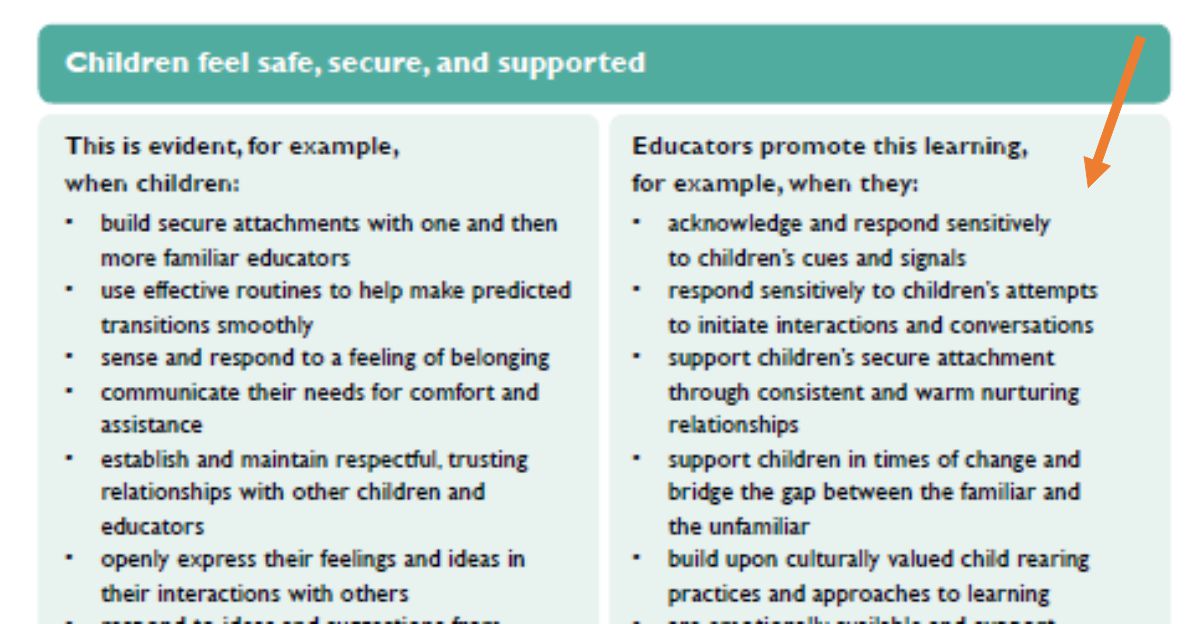
You will see the above is the five Learning Outcomes from the EYLF. The EYLF gives educators the exact ways to make these curriculum decisions by giving us the right-hand side indicators.

Educators promote this learning, for example, when they:”

Above copied from the EYLF book

With this knowledge the element is easy to exceed in with a simple two-part process. Firstly, look at what makes curriculum, then use the right -hand side of the EYLF Learning Outcomes for the decision.

Below is an example from ‘interactions

We will represent the right-hand side of the EYLF learning Outcomes showing what the educator is doing to extend children’s knowledge in blue type. This is your planning/decision process and it shows how you meet element 1.1.1

The Slippery slide

Today Iylah, Charlie and Zayne used the foam blocks as a slippery slide. They transferred knowledge from one setting to another by recognising the shape of the blocks to be the same as a slide.

Sam sat with the children assisting them and talking to them as they shared happiness and humour with each other. Iylah climbed to the top of the block as Sam assisted her to slide down while sitting. Charlie knew he wanted to slide on his belly.  He laid down and giggled as he slid to the bottom.

Iylah watched Charlie slide on his belly and wanted to try. She held her hand out towards Sam for assistance. Sam supported Iylah to construct multiple solutions to problems and use different ways of thinking by encouraging her to work out how to move to lay on her belly to slide down the block by herself. Sam suggested Iylah move backwards to make room for her hands to support her to turn around. Iylah had many turns at the slide and experimented with different ways to go. Learning outcome 4.2, 4.3 & 3.1

Look at the examples and start writing like this to show how you are meeting element 1.1.1.

Curriculum – Interactions

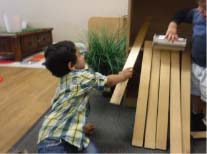
Today Sam (Educator), Carter and Adrian used the open ended resources to investigate, take apart, assemble, invent and construct their ideas and made a game. Sam and Adrian worked together to make a ramp out of the planks. Carter saw the opportunity to use this as a ramp to push down some open ended resources like a yoghurt tub which was square in shape. Sam provided Carter and Adrian with exploratory experiences with natural and processed materials.
When the yoghurt tub didn’t roll but slide down the ramp Sam provided Carter and Adrian with round tin cans, rocks, pinecones, milk lids, pom-poms and coffee cup lids to experiment and see if each resource rolled or slid down the makeshift plank ramp.

Adrian and Carter took turns at putting resources down the ramp and cheered each time the resource rolled down.

Learning outcome: 4.4

This morning in our outside playground Slader, Sarah and Aria initiated and joined in play experiences with their peers.

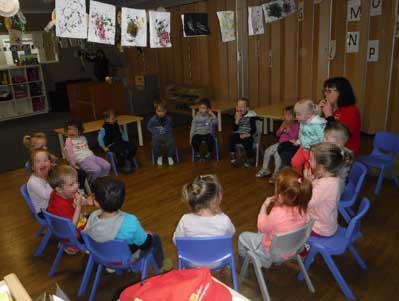
While sitting at the table Miss Ashlee suggested that the children put some sand on the table to draw. “Draw?” Aria repeated as she got a handful of sand and placed it on the table. Slader and Sarah then picked up a handful of sand also. Miss Ashlee spent time interacting and conversing with each child as she asked the children what pictures they were drawing. “Rainbow” Sarah said excitedly. “Patterns” Aria screamed with a big grin on her face. After Joey saw his friends having so much fun drawing he decided to join in. Both Joey and Slader shared smiles with Miss Ashlee.

Trial and Error
During group time Sam showed Nate, Patrick, Eva and Archie how static electricity works. Sam blew up a balloon and ripped up pieces of paper to create the activity.

Sam intentionally scaffolded the children’s understanding of static electricity by modelling scientific language, and talking to the children about how it works by charging the balloon up with friction using hair or fabric fibres where we can see it working as it attracts hair particles, and picks up pieces of paper.

To show the children how friction works, Sam demonstrated this by using the balloon, rubbed on hair which we saw it lift the hair pieces and lift the paper. Nate used the trial and error method to create friction by rubbing the balloon on his hair to lift the paper. When the paper didn’t lift he rubbed the balloon on his hair and asked Sam to help him. Sam provided assistance to help Nate create friction to lift the paper. He was quite excited to see he had created enough static electricity to cause the paper to stick to the balloon.

Who is in the box?

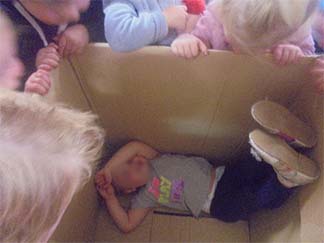
This morning Toddler 2 experienced hiding inside a large box. At first the children explored it. Then Cherie (educator) encouraged the children to take turns at being ‘Jack in the Box.’ When the flaps of the box were opened the child popped up and everyone said the child’s name. The children co-operated and worked collaboratively with the educator.  Cherie showed genuine affection, understanding and respect for each child.  Aaron, Eli, Eden, Ava and Kloe didn’t want to hop out of the box when their turn was up. The aim of the game was to promote listening and response to verbal cues. It also gave experience at turn taking as the children had to learn to wait for their turn.
Curriculum – Experiences

This morning while outside toddler 2 actively participated in group experiences and showed interest in their peers, while using their physical skills to engage in running races.

We began by running backwards and then we pretended to be different animals. When we were tigers the children began using their hands as claws and roaring like one as well. We soon then changed to elephants and the children would lift their arms up and pretend they were trunks swaying in the breeze.

Emma and Cody (educators) would model explict communication strategies to support children to initiate interactions and join in play and social experiences in ways that sustained productive relationships with other children. When monkeys we scratched under our arms and lastly, we slithered like snakes.

Emma and Cody provided a range of active and restful experiences throughout the morning and supported the children to make the appropriate decisions regarding participation. Emma

Curriculum – Routines

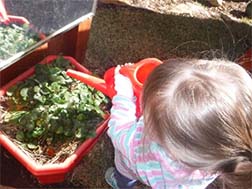
As a part of or daily routine we Olivia, Emma (educator) and Rachel (educator) watered the strawberries. Rachel enabled Olivia to care for and learn from the land. We talked to her and showed her how and why we water the plants so they can grow big and strong to produce flowers and fruit for us to eat.
Olivia felt the water as it spilled out from the spout with her hand. She giggled and said “cold.” She looked at Emma who smiled back as she formed a connection with educators.

Olivia explores the relationship with other living and non-living things by understanding that we as living things, need to water the plants so they can produce food for us. Olivia also explored the relationship between the non-living gardening tools needed to keep the living plants alive as they assist and provide care for it.

Exercise routine

Our normal exercise routine was moved indoors today because it was wet and cold so Kymmy and Emma organised dance. The educators provided resources that enabled the children to express meaning using dance. The children used dance to express ideas and make meaning. We danced to the children’s favourite Baby Shark and some old favourites like Hokey Pokey. We went on to play musical chairs and pass the parcel. These games taught us spatial awareness and accentuated our listening skills.



Curriculum – Planned Activities

To extend upon the children’s interest in counting and numbers Miss Kymmy J gave the children some dice to roll. Ariah after rolling the dice was counting the numbers on them. Kymmy J recognises mathematical understandings that children bring to learning and builds on these in ways that are relevant to each child by drawing up a copy of the dots in the same pattern as the dice on an A4 piece of paper. Lydiah was able to apply her mathematical knowledge to problem solving, by helping Ariah, showing her which number matched her dice on the paper. When it was Lydiah’s turned she was very confident and told Ariah she didn’t need help. Chase was keen to have a go at rolling the dice and matching the numbers up too.

The children are enjoying the counting activities in the room.

Extending on mathematical ideas

This morning toddler two participated in a different activity with measuring different items from around the room.

Exceeding Theme Core

All educators work collaboratively with the educational leader, and regularly engage with families and the community, to consistently make curriculum decisions which maximise learning and development outcomes for every child in relation to their identity, connection with community, wellbeing, confidence as learners and effectiveness as communicators. All educators regularly reflect on practices to ensure they support the rights of every child to participate and achieve learning outcomes. 

Where is your practice compared to the above statement?

_________________________________________________
_________________________________________________
_________________________________________________
_________________________________________________
_________________________________________________
_________________________________________________
_________________________________________________


How do you know if you are doing a good job?

How do you know if you are doing a good job?

4.2.1, 4.2.2, 6.1.2

We need to open a space and time to allow our team to communicate. Firstly you are going to discover what your educators think of your room leading skills. Secondly you are going to give feedback to your educators regarding their skills and plan for them to improve.
Room Leader: Ask the following question of each educator in your team.
Do you feel I have coached you to develop partnerships with families eg so you feel confident to share information with them about their child’s learning, to take parents to the curriculum wall and discuss activities, to encourage parents to share information about their child, home routines, daily lives and weekends to create curriculum?

Educator’s Names strongly agree agree neutral disagree strongly disagree Educator’s comments
Courtney I get very nervous

Educators: Ask the following question of your Room Leader.
After I greet parents, do you feel I have good conversations with them about things like their jobs or hobbies, how their day’s been, what their child learnt, who they played with, their child’s activities and interests outside the service, what’s happening at the family home?

Educator’s Names strongly agree agree neutral disagree strongly disagree Room Leader’s comments

How to identify goals to work on – Goal template

Identifying and working to achieve goals is a simple way to help people improve.

The following goals are examples and not an exhaustive list. We suggest you develop goals based on the issues or problems you’re having in your room/service.

Relationships with Children

1.1.1, 1.1.2, 1.2.3, 2.1.1, 2.1.2, 5.1.1, 5.1.2, 5.2.2, 6.1.2, 6.2.1

  • Show children by our actions they can trust us and that we’re always there for them
  • Improve the quality and amount of information on children and families we share with team members
  • Increase our expectations for all children and consistently encourage them
  • Reflect on whether we’re really including each child’s interests in the curriculum
  • Look for the reasons children act inappropriately and never blame the child
  • Change teaching practices to work with each child’s strengths and preferred learning styles
  • Include children in setting rules for the room and outdoor play area
  • Focus more on teaching children about emotions and feelings
  • Increase interactions with children who are quieter and less outgoing than other children
  • Include more activities which are based on children’s cultures and heritage
  • Implement home visit program for new and current children

Relationships with Families

6.1.1. 6.1.2, 6.1.3, 6.2.1, 6.2.2, 6.2.3

  • Learn to confidently talk to all parents at drop off and pick up times
  • Learn all parents’ names
  • Improve the quality and amount of information on children and families we share with team members
  • Provide more interesting information about each child’s day and learning with their family
  • Encourage families to share relevant information by discussing child’s daily routines at service, interests, achievements etc
  • Increase level of family input and showcase it in our curriculum
  • Advise all families about our complaints procedure and who to contact
  • Discuss available inclusion support at next staff meeting
  • Educational Leader to discuss access to inclusion support with relevant families
  • Clean up parent library so it’s attractive and has current information on parenting and community organisations
  • Invite families to an evening sausage sizzle once every quarter
  • Implement a Facebook Page open to service families only
  • Review our orientation procedure for families and children to make sure everything covered

Relationships with Community

6.2.2, 6.2.3

  • Choose several community organisations to develop connections with eg organisations which children or families attend, cultural groups or relevant businesses
  • Learn more about local support services and organisations

Safety

2.1.2, 2.2.1, 2.2.2, 2.2.3

  • Properly implement a risk management process – identify, assess, remove/ minimise, monitor
  • Always assess risk of new equipment and activities before involving children
  • Teach children how to safely use equipment and complete activities
  • Learn to immediately remove or reduce an identified risk
  • Understand what effective supervision requires eg constantly supervise children when included in ratios – no phones etc
  • Always tell team members if moving locations or temporarily leaving the room
  • Be able to confidently discuss children’s medical managements and risk minimisation plans
  • Practise our emergency evacuation procedures more often to increase confidence of children and staff
  • Practise all identified emergencies eg lockdowns

Child Protection

2.2.3

  • Learn to confidently identify the indicators of abuse and neglect
  • Ensure everyone’s aware of service visitors and never leave children alone with them
  • Be aware of what team members are doing and take action if they take children into secluded areas
  • Learn how to report abuse or neglect
  • Ensure educators always speak appropriately in front of children

Sustainability

3.2.3

  • Include more practices which protect and respect the environment in service operations
  • Include more learning and activities about environmental issues and practices in our curriculum
  • Ask families for clean milk containers and get children involved in planting herbs etc in them

Professional Interactions

4.2.1, 4.2.2

  • Learn to recognise and use the unique skills and knowledge all team members bring
  • Improve understanding of professional interactions eg appearance, respect, interactions, privacy
  • Look for solutions to staffing issues, room routines, cleaning duties etc
  • Speak directly with a team member about issues of concern and tell them how you feel/why this is a problem for you
  • Learn to confidently implement the complaints procedure if there’s still an issue after talking with the person
  • Learn to confidently share knowledge and ideas about teaching practice

Teamwork

4.1.1, 4.2.1, 4.2.2

  • Improve the level of support and encouragement provided to team members
  • Get all team members to understand that it is everyone’s job to clean and comfort and care for children
  • Improve the level of communication between team members so we all know what’s happening and who may need help
  • Have regular 5-10 minute team meetings

Collaborative learning

1.1.1, 1.1.3, 3.2.1, 3.2.2, 5.2.1

  • Increase opportunities for children to share ideas and knowledge
  • Be confident to research issues that I don’t know anything about and learn with the children
  • Rearrange the outdoor spaces so children can engage in small, uninterrupted group play
  • Collect lots of natural resources for loose parts play and bring inside the room

Intentional Teaching

1.2.1, 1.2.2

  • Become more aware of opportunities for intentional teaching eg as they emerge from daily activities and experiences
  • Educational Leader to highlight cases from previous week’s curriculum/documentation showing educators how they could have implemented intentional teaching

Extending learning

1.1.1, 1.1.2, 1.2.1, 1.2.2,

  • Look for opportunities to extend learning that can go on for days or even weeks
  • Learn to extend learning without relying on equipment eg use children’s relationships and connections with community
  • Educational Leader to highlight cases from previous week’s curriculum/documentation showing educators how they could have extended learning

Physical Activity

1.1.1, 1.1.2, 1.2.1, 2.1.3, 6.1.3

  • Increase the amount of physical activity included in the daily curriculum
  • Learn to recognise the physical activity that is included in daily activities eg cleaning, getting resources, emptying compost
  • Implement new activities eg yoga, dance, ball skills
  • Reduce the amount of time children spend watching TV, YouTube etc at the service
  • Increase the amount of physical activity which offers challenges to children eg climbing trees

Healthy eating

1.1.1, 1.1.3, 1.2.1, 2.1.3, 6.1.3

  • Only eat healthy food in front of children
  • Talk about healthy food more with children eg what makes it healthy, how to cook eat, how it tastes, how to grow it
  • Improve our service veggie garden
  • Implement more cooking activities with children
  • Learn more about the Australian Dietary Guidelines/Infant Feeding Guidelines
  • Review our menu against the Australian Dietary Guidelines/Infant Feeding Guidelines
  • Provide more information to families about healthy eating eg simple and quick recipes, info on salt/sugar

Hygiene

1.1.3, 1.2.1, 2.1.2, 3.1.2, 6.1.3

  • Improve our knowledge about infection control procedures
  • Learn to always implement infection control procedures
  • Teach children cough, sneeze, nose blowing etiquette
  • Learn when we should be wearing gloves
  • Learn to reduce incidences of cross contamination
  • Learn how to store perishable food properly
  • Learn how long perishable food can be kept at room temperature
  • Increase the number of times the bathroom/toilet is cleaned daily
  • Make sure the room is clean and tidy at the end of every day
  • Develop or improve our cleaning schedules
  • Learn to confidently refuse entry to children who are ill or may have an infectious disease

Physical environment

2.2.1, 3.1.1, 3.1.2, 3.2.1, 3.2.2, 3.2.3

  • Display a supervision plan ie where educators must stand in the outside play area
  • Sand the wooden cubby house to remove all splinters of wood
  • Ensure all educators know how to clean and maintain the sandpit,
  • Replace sliding door so children can move more easily from indoor to outdoor environment
  • Implement progressive morning teas which allow children to move freely around environment and activities
  • Design a dry creek bed for outdoor area

Learning Documentation

1.3.1, 1.3.2, 1.3.3, 7.2.2

  • Learn to write less but make it more meaningful
  • Learn not to repeat what’s in a photo
  • Learn how to document progress or achievement of learning outcomes
  • Keep portfolios up to date so there is no mad rush at the end of the year
  • Involve children in completing their learning documentation
  • Keep a current record of children’s progress against the learning outcomes
  • Improve the way we display our learning documentation to encourage family involvement

Business Practices

7.1.1, 7.1.2, 7.1.3, 7.2.1, 7.2.2, 7.2.3

  • Improve our recruitment and induction practices
  • Hold monthly staff meetings for all service staff
  • Invite all staff members to contribute to staff meeting agenda
  • Complete annual professional development appraisals with training plans
  • All staff members can calculate ratio requirements for children at service
  • Improve management systems to ensure staff always have appropriate qualifications and child protection clearances eg diary system and registers maintained
  • Work on Quality Improvement Plan every week
  • All staff contribute to Quality Improvement Plan
  • Progress notes are added to Quality Improvement Plan every week where relevant
  • Improve the security of personal information
  • Ensure that records which are archived for certain periods in line with the Regs are accessible and easy to identify
  • Ensure all staff members know what a serious incident is
  • Ensure all staff members know that complaints about a breach of the law or that the health or wellbeing of children is being compromised must be reported to the Department

Business Documentation

7.1.1, 7.1.2, 7.2.3

  • Look up those policies and procedures we’re not very familiar with
  • Use the ACECQA Guide to the Regulations to become more familiar with the Regulations
  • Use the Use the ACECQA Guide to the NQS to become more familiar with the NQS
  • Make it easier to access our policies and procedures, and the Regs/NQS
  • Develop an organisation chart which clearly shows who everyone reports to
  • Develop a new Statement of Philosophy which is based on our core values

Business Practices

7.1.1, 7.1.2, 7.1.3, 7.2.1, 7.2.2, 7.2.3

  • Improve our recruitment and induction practices
  • Hold monthly staff meetings for all service staff
  • Invite all staff members to contribute to staff meeting agenda
  • Complete annual professional development appraisals with training plans
  • All staff members can calculate ratio requirements for children at service
  • Improve management systems to ensure staff always have appropriate qualifications and child protection clearances eg diary system and registers maintained
  • Work on Quality Improvement Plan every week
  • All staff contribute to Quality Improvement Plan
  • Progress notes are added to Quality Improvement Plan every week where relevant
  • Improve the security of personal information
  • Ensure that records which are archived for certain periods in line with the Regs are accessible and easy to identify
  • Ensure all staff members know what a serious incident is
  • Ensure all staff members know that complaints about a breach of the law or that the health or wellbeing of children is being compromised must be reported to the Department

Reflection

1.3.2, 7.2.1

  • Learn to reflect on better ways to do things during daily activities
  • Learn to think about things as if I was a child, parent, colleague etc – how might I feel, what might I think?
  • Develop a mindset of continuous improvement – there’s always a better way to do things

Select two goals


What are your educators doing at any given time?

The Story of Cinderellas

Cinderellas is a magical long day care service that had two incredible people working there together for the past 30 years. These two women were so in tune with each other few words were needed as they did this magical dance in the rooms and outdoors with each other. They knew exactly what to do to make a day flow. If one did a task, for example ran grouptime, the other set the room up for the next experience. This magical teamwork flowed because they both knew exactly what was needed when working with the children. When a little mishap occurred, which it always will with children, the flow continued with the issue easily resolved. Each educator could step in and do the other’s job when required – no asking or directing. They just knew what was required, could sense all problems and solve them before they even occurred. One time a child was doing something they weren’t supposed to. Facing the opposite direction the educator, without looking up from wiping the tables, redirected the child who was about to climb the bookshelf to a more appropriate area. The child looked amazed as the educator appeared to have eyes in the back of her head.

Managing Educators’ Time to achieve positive outcomes

Unfortunately, Cinderellas doesn’t exist in most services, especially with our high staff turnover.  Don’t panic – a proper run sheet for the room can make any service a Cinderellas. While a routine is a broad-brush stroke of the day, a run sheet breaks the routine down and assigns jobs to specific educators to ensure the routine is completed. Please note strict routines with exact times like this are not needed for everyone or every room. However, walking into a room where it is complete chaos because no educator knows what to do indicates the room requires a run sheet.

See below Emma’s run sheet that she needed to create for her room.

Time Main Activity Support Activity 1 Support Activity 2 Support Activity 3
6.30 Family grouping
8am Outdoor play, greet parents, get weekend sheetsWho: Emma H
9am Positive story for behaviour Who: Emma H Nappy change Who: Cherie
9.10am Helper chart Who: Emma
9.20am Progressive morning tea Who: Cherie – Welcome (Good morning)
– Who is here today activity
– What do you want to do today? A-frame plan with children
Emma H
Planned physical activity – outdoors
Who: Tayla
Set up for group time
Who: Eliza
9.50am Children clean as per helper charts
Who: Eliza
Transition from Outdoors to indoors
Who: Tayla
Assist with transition
Who: Cherie
 10am Planned group time (Topic/interest/family input)
Who: Emma H
 Set up room
Who: Tayla
Word wall
Who: Emma H
10.40am Free play as planned with children A-Frame indoor/Outdoor
11.10 Direct children to pack away
11.20am Small group/Table activities
Table 1 – Name recognition/writing
Eliza
Table 2 – Art and craft table
Who: Cherie
Table 3 – Will change depending on interests/family input
Who: Tayla
Group 4 will complete an activity on the mat
Who: Emma H
12pm Yoga or brain gym
Who: Tayla
Put beds out
Who: Eliza
Nappy change/rest nappies
Who: Eliza
12.15pm Lunch set up by children as per helper chart:
Who: Emma H
12.30pm Quiet time/Rest time
Who – Emma  H
Sit with resting/sleeping kids
Who: Eliza
Clean up after lunch
Who: Tayla
Look at the strength tree
Who: Eliza
Mop the floor
Who: Emma H
Write on curriculum
Who: Tayla
Bathroom Cleaning
Who:  Cherie
  Curriculum
Who: Cherie
Set up for lesson plans
Who: Eliza
2pm Lesson plans (Small groups)
Who: Emma H
Lesson plans (Small groups)
Who: Cherie
Lesson plans (Small groups)
Who: Tayla
2.30pm Group time
– What was the best thing about school today?
– What didn’t you like?
– How can we make it better?
Who: Eliza
Nappy change/remove rest nappies
Who: Tayla
Write on curriculum
Who: Emma H
Add new words to word wall
Who: Tayla
3pm Progressive/Afternoon Tea
Who: Tayla
Singing/Dancing/dramatic play
Who: Cherie
Curriculum
Who:  Eliza
3.30pm Refer to Helper chart – recycling, watering plants
Who: Tayla
Bags packed, shoes, hats and sunscreen on
Who: Cherie
Tidy lockers & take washing to the laundry
Who: Eliza
All parents taken to the curriculum wall and described children’s learning
Who: All staff
A-Frame – Choose again what the children want to do
Who: Eliza
4pm Outside Play
Who: Cherie
Outside play
Who: Tayla
Clean room:
Eliza
4.30pm Go inside and remaining children discuss what they want to do tomorrow
Who: Cherie
5pm Prepare the room with the children
Who: Eliza
6pm Finish

What is coaching?

Coaching

I often hear people say ‘they’ don’t know what ‘they’ are doing and ‘they’ have no common sense. However, what I usually see is a lack of experienced educators teaching less experienced educators.  So I’d like to work with you on the process of coaching.
What is coaching?
Coaching can be used to develop people’s skills, improve their performance, explore goals and correct inappropriate conduct. It typically takes place as a conversation between two people and focuses on an agreed goal. The coach then helps the other person to learn new things themselves rather than having new ways imposed on them. This approach is more likely to provide a lasting result.
How do I coach someone? 
The GROW model – think about

  1. GOAL – what you want to achieve
  2. REALITY – what’s happening now
  3. OPTIONS – what you could do –
  4. WAY FORWARD – what you’ll do

Practical Example
Mandy’s been a trainee for 6 months. She’s a hard worker, studying well and is forming great relationships with the children and team members. Her portfolios and programming are coming along nicely – but some families have said they’re not happy with her communication.

  1. GOAL

Mandy and her Room Leader Tracy discuss the family feedback. They agree Mandy needs to become more confident communicating with families and set a timeframe of 4 weeks.

  1. REALITY

Tracy and Mandy discuss:

  • how Mandy feels when a parent approaches her
  • what Mandy thinks her role is in building strong partnerships with families
  • her understanding of service policies and procedures on communication
  1. OPTIONS

Tracy and Mandy brainstorm ideas and develop a plan involving:

  • training in relevant policies and procedures
  • Mandy to stand with Tracy while Tracy models appropriate communication with families
  • Tracy to support Mandy while Mandy speaks with families and then provide constructive feedback
  1. WAY FORWARD

Nominated Supervisor speaks to parents after 4 weeks. They acknowledge a marked improvement in Mandy’s confidence, saying she now talks with them about their child’s learning. Nominated Supervisor implements a regular parent feedback tool to monitor all educators’ communication.
Mandy now has aspirations to be a Room Leader one day and continues to grow in confidence.

Tracy has added communication with families to all weekly meeting agendas to maintain the focus on communication.

Coaching plan in action

Coaching can be used to develop people’s skills, improve their performance, explore goals and correct inappropriate conduct. It typically takes place as a conversation between two people and focuses on an agreed goal. The coach then helps the other person to learn new things themselves rather than having new ways imposed on them. This approach is more likely to provide a lasting result.

How do I coach someone? 

GROW model steps Write out your steps to meet your selected goals
1.GOAL  – what you want to achieve
2.REALITY – what’s happening now
3.OPTIONS  – what you could do –
4.WAY FORWARD  – what you’ll do

Who to talk to about what?

Practical Management – Who to talk to about what?

What I find in most services is educators asking the wrong person for help because they don’t know who does what. I’ve talked about runny poo on many occasions because I’ll never forget the time I watched five people waste so much time investigating a child’s runny poo and collectively attempting and failing to decide what the best action was to move forward. When people don’t know who to talk to, they waste their own time and that of all the other people who should not be involved.

Educators

Educators talk to their Room Leaders about:
  • their roster
  • room routines
  • training needs
  • curriculum eg planning, activities, extending learning, intentional teaching
  • children’s portfolios
  • learning documentation eg learning stories, child reflections, strength trees, photos
  • assessing children’s learning
  • room displays
  • cleaning responsibilities
  • resources and equipment - new or replacement
  • difficulties with other team members they can’t resolve directly with the person
  • any issues that affect their job
  • difficulties managing children’s behaviour
  • service operations
  • their own special skills, hobbies etc so these may be used to strengthen the curriculum (can be areas not related to childcare)
  • policies or procedures
  • learning outcomes, NQS elements and Regs
  • individual children eg health needs, children’s medication and/or medical plans, interests, comfort routines, family structure
  • individual families eg jobs, names, family structure, hobbies, holidays
  • how to improve everyday skills and procedures eg teaching, documenting, reflecting, talking to families, managing and interacting with children, identifying behavioural needs, time management
  • feedback for Quality Improvement Plan
  • templates and forms
  • record keeping and filing
Educators share information with other educators about:
  • their own special skills, hobbies etc so these may be used to strengthen the curriculum (can be areas not related to childcare)
  • children and families that other educators may not know (only appropriate information, nothing that breaks confidentiality or is not needed to be said i.e. gossip)
  • things they’ve learnt from training/professional development
  • better ways to do things eg including children’s names in the stories they’re reading
  • their movements during the day, especially if supervising children. For example I’m taking Ava in for a Nappy Change now…I’m taking these four children to the printer to get or learning stories.
  Educators talk to Educational Leader about:
  • curriculum eg planning, activities, extending learning, intentional teaching
  • compiling children’s portfolios
  • completing learning documentation eg learning stories, child reflections, strength trees, photos
  • assessing children’s learning
  • their reflective practice and critical reflections
  • their own special skills, hobbies etc so these may be used to strengthen the curriculum (can be areas not related to childcare)
  • learning outcomes
Educators teach, coach, then assess trainees in:
  • policies and procedures
  • learning outcomes, NQS elements and Regs
  • curriculum eg planning, activities, extending learning, intentional teaching
  • compiling children’s portfolios
  • completing learning documentation eg learning stories, child reflections, strength trees, photos
  • assessing children’s learning
  • making beautiful room displays
  • their cleaning responsibilities
  • their knowledge about individual children eg their health needs, medication and/or medical plans, interests, comfort routines, family structure
  • their knowledge about individual families eg jobs, names, family structure, hobbies, holidays
  • everyday skills and procedures eg teaching, documenting, reflecting, talking to families, managing and interacting with children, nappy changing and toileting, the correct way to complete an incident/accident form if they were a witness
  • templates and forms used
  • record keeping and filing
  Educators talk to Nominated Supervisor about:
  • personal illness, injury etc that affects their work
  • difficulties with other team members that they can’t resolve directly with the person or with the help of the Room Leader
  • any issues that affect their job if Room Leader can’t resolve them
Educators talk to Administration Manager about:
  • pay issues
  • qualifications eg updating First Aid or Child Protection Clearance, working towards qualifications
  • enrolment of children information relevant for their room

Trainees

Trainees talk to Educators and the Room Leader about:
  • rosters
  • policies and procedures
  • learning outcomes, NQS elements and Regs
  • curriculum eg planning, activities, extending learning, intentional teaching
  • compiling children’s portfolios
  • learning documentation eg learning stories, child reflections, strength trees, photos
  • assessing children’s learning
  • making beautiful room displays
  • cleaning responsibilities
  • individual children eg their health needs, medication and/or medical plans, interests, comfort routines, family structure
  • individual families eg jobs, names, family structure, hobbies, holidays
  • how to improve everyday skills and procedures eg teaching, documenting, reflecting, talking to families, managing and interacting with children, nappy changing and toileting, how to complete incident forms
  • templates and forms used
  • record keeping and filing
  • service operations
Trainees talk to Administration Manager about:
  • holiday plans
  • pay issues
  • qualifications eg working towards qualifications
  Trainees talk to Nominated Supervisor about:  
  • sick leave
  • personal illness, injury etc that affects their work
  • difficulties with other team members that they can’t resolve directly with the person or with the help of the Room Leader
  • holidays

Room Leaders

Room Leaders teach, coach, then assess educators and trainees in areas that need improving eg:
  • relevant policies and procedures eg nappy changing and toileting
  • learning outcomes, NQS elements and Regs
  • basing daily program on family input and children’s lives, extending learning, intentional teaching
  • compiling children’s portfolios
  • completing learning documentation eg learning stories, child reflections, strength trees, photos
  • assessing children’s learning
  • making beautiful room displays
  • their cleaning responsibilities
  • their knowledge of individual families eg parents’ names and jobs
  • everyday skills and procedures eg documenting, reflecting, talking to families, managing and interacting with children teaching, identifying behavioural needs, time management, how to complete incident forms
Room Leaders talk to educators and trainees about:
  • rosters
  • their training needs
  • room routines
  • curriculum eg planning, activities
  • resources and equipment - new or replacement
  • managing children’s behaviour
  • service operations eg information they’ve learnt that team members may not know
  • their own special skills, hobbies etc so these may be used to strengthen the curriculum (can be areas not related to childcare)
  • policies or procedures
  • learning outcomes, NQS elements and Regs
  • individual children eg their health needs, medication and/or medical plans, interests, comfort routines, family structure
  • individual families eg jobs, names, family structure, hobbies, holidays
  • feedback for Quality Improvement Plan
  • information they’ve learnt about children and families
information they’ve learnt while completing training/professional development better ways to do things eg speaking to children at their eye level their movements during the day, especially if supervising children   Room Leaders talk to Administration Manager about: new families and children eg enrolment information holiday plans pay issues qualifications eg updating First Aid or Child Protection Clearance templates and forms used record keeping and filing service operations Room Leaders talk to Nominated Supervisor about: personal illness, injury etc that affects their work difficulties with team members that they can’t resolve directly with the person educator and trainee training needs any issues that affect their ability to manage the room or do their job

Families

Families talk to Nominated Supervisor about:

  • issues they can’t resolve with Room Leader
  • service operations
  • complaints, suggestions, feedback
  • obtaining information to support parenting and families
  • problems with educators they can’t resolve with the Room Leader
  • complaints related to the Room Leader
  • content of policies and procedures

Families talk to Administration Manager about:

  • enrolment
  • fee payments
  • child’s attendance
  • planned holidays
  • updated information eg current enrolment, immunisation, emergency contact details
  • service operations
  • parent information library
  • location of policies and procedures

Families talk to Room Leader about:

  • their child’s learning and development
  • what’s in learning program
  • their child’s learning records
  • their child’s friendships and groups
  • their child’s social interactions
  • behaviour issues
  • service operations
  • obtaining brochures or contacts which support parenting and families

Administration Manager

Administration Manager talks to Room Leaders about:

  • updated information for children and families (relevant to teaching and relationships)
  • students, volunteers and relief staff
  • location and supply of forms and templates
  • filing of records

Administration Manager talks to Educators about:

  • qualifications eg updating First Aid or Child Protection Clearance, working towards qualifications

Administration Manager talks to Nominated Supervisor about:

  • complaints, suggestions, feedback
  • late fees
  • budget
  • relevant staffing issues eg staff holidays
  • students, volunteers and relief staff
  • staff rosters
  • new enrolments
  • terminating families
  • occupancy rates

Nominated Supervisor

Nominated Supervisor talks to Administration Manager about:

  • students, volunteers and relief staff
  • financial information eg budget

occupancy rates

Nominated Supervisor talks to Room Leader about:

  • difficulties with staff they can’t resolve directly with the person
  • training needs – their own and those of educators and trainees
  • management of room
  • children’s curriculum, learning documentation and portfolios
  • communication with families
  • feedback for Quality Improvement Plan

Nominated Supervisor talks to Educational Leader about:

  • children’s curriculum, learning documentation and portfolios
  • communication with families
  • educators’ training needs