
Helping your educators understand the EYLF and documentation


Just another Centresupport site
Clearly Defined Reporting Relationships are Required for Effective Leadership
Everyone in the Service must only have one primary manager. This reduces confusion and increases accountability and transparency. If educators or staff do not follow clearly defined reporting relationships, the primary manager loses the ability to manage and lead their direct reports. In your room this could happen, for example, if your Room Assistant goes directly to the Nominated Supervisor. These types of actions have the ability to destroy a service.
Below are some examples of how the reporting relationship can fail. This is turn leaves the person in the middle powerless, devalued and unable to do their job.
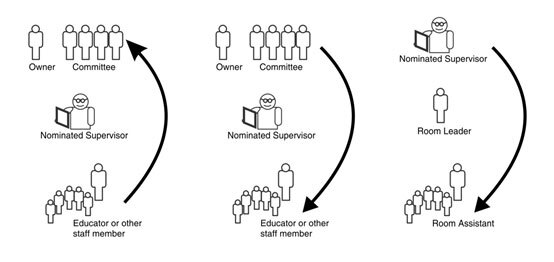
Your reporting relationships should include:
Information, requests or delegations to educators to take action or change their actions should only come from the person to whom they report ie you as Room Leader. Make sure each of your educators understands and adheres to this reporting relationship.
“Words are only 7% of your communication
38% is voice tone
55% is body language”
Emotions are linked to your body language.
If you feel good you’ll smile.
If you force yourself to smile you’ll feel good.
Professor Albert Mehrabian

“When I begin a training session no matter what it is, I always acknowledge each person as a professional and I remind them that they are professional men and women who have sound knowledge of Early Childhood Teaching practices.” Ann Webb
You could use a daily checklist and weekly report like those on the next pages to develop your KPIs.
__________ the _____/______/_______
Educators:________________________________
As a Room Leader it is your job to assign the tasks to yourself, educators and children.
How are you going to have a great day today? Ask everybody in the room this question every morning.
| Duties | Who? | M | T | W | T | F | Comment |
|---|---|---|---|---|---|---|---|
| Wash tables and table legs after every meal with a cloth and a bucket of water with soap | |||||||
| Clean all glass in windows and doors | |||||||
| Clean all pen, marker, crayon, paint, glue etc marks from tables, furniture, walls and floor | |||||||
| Vacuum the sliding door slots at the bottom to remove sand. Children will love this job. Guaranteed! | |||||||
| Sweep the floor after every meal | |||||||
| Clean door handles so there are no dark marks and they feel clean | |||||||
| Make sure educators work desks are SPOTLESS and there’s no dust. Baskets are below desk in ordered fashion –baskets are not on top of desks in a mess | |||||||
| Make sure top of the lockers is spotless and well presented | |||||||
| Ensure all power point have safety plugs and cords are safe | |||||||
| No furniture is placed against walls and skirting boards | |||||||
| Bathrooms cleaned including around behind the toilets and in front of the toilet. Floors mopped in ALL bathrooms | |||||||
| Use the bathroom cleaning checklist daily. No more smells… | |||||||
| Every room sweeps the paths and veranda before they come inside. Remember children will help | |||||||
| Education | |||||||
| Strength Trees completed and curriculum built from them | |||||||
| One direct teaching lesson per day per educator (This can be how to use the equipment) | |||||||
| One intentional teaching lesson with children as it happens (Extending children’s learning) | |||||||
| Curriculum completed with children | |||||||
| Tables and work areas set up and displayed beautifully | |||||||
| Letter sent to parent with children's work |
How many times have educators contributed to the curriculum and learning stories and assessments
| Monday | Tuesday | Wednesday | Thursday | Friday | Total |
| Educator | |||||
| Matt | |||||
P: Obtained parent Input C: Curriculum LS: Learning Story ST: Strength Tree CRS: Child Reflection Sheet.
| Weekly Duties | Who? | M | T | W | T | F |
|---|---|---|---|---|---|---|
| 1. Make sure work stations have new activities in them each week | ||||||
| 2. Clean skirting boards with water in bucket with soap and cloth | ||||||
| 3. Use the vacuum cleaner to clean all furniture (children will love it). Give bookcase, tables, dress up area a really good wash with bucket of soap and water and a cloth. Do not use spray and cloth) Remove dirt from back of corners | ||||||
| 4. Vacuum lockers and wash with water in bucket with soap and cloth. Dry after wiping. | ||||||
| 5. Sort the rocks in the creek bed | ||||||
| 6. Gumption the outside bubblers | ||||||
| 7. Gumption the inside taps and basin in bathroom |
Keep in folder for Nominated Supervisor to check. Friday sign when complete ________________________________________
Room Leader Weekly Report to Educational Leader and Director/ Nominated Supervisor
The outcome of this report should:
Room:____________ RL Name: ________________ Date: ____/___/____ Educator Names:
| 1. What were three of your achievements this week? | ||
| 2. How did you and your educators grow professionally this week? ie what did you learn | ||
| 3. What were three of your challenges this week? | 4. What assistance or training do you or your educators require? | |
| 5. Were there any issues regarding the children? eg behaviour, illness, development concerns, not settling, extended crying etc. | 6. Were there any issues regarding the families? Eg lost shoes, clothes, behaviour of other children, not seeing curriculum etc. | |
| 7. What child related training do you or your educators require? | 8. What parent related training do you or your educators require? | |
| 9. Did you accomplish your tasks this week, including managing the room educators to complete their tasks? Yes No 10. How can you improve? |
11. Describe a situation where you felt the room educators did not respond to your instructions, advice or management were managed poorly delete? What could you do to improve? | |
| 12. Did you need to speak to your educators or teachers from other rooms regarding their performance (based on their job description), routine, core values, tasks etc? Yes No 13. If Yes what was it concerning |
14. If “Yes” was the Nominated Supervisor notified? Yes No | 15. Nom Sup – to complete if notified
|
| 16. What assistance do you need from the Director/Nominated Supervisor? | 17. What assistance do you need from the Educational Leader? | |
Room Leader signature: _____________________
Date: ___/___/____
Director/Nominated Supervisor Signature: ___________________
As a leader you need accurate information to make decisions quickly and to lead your team. Key Performance Indicators can be one way to measure the success of your room or identify areas that require improvement.
Setting and Using KPIs
Setting and measuring KPIs is a way of ensuring your educators stay on track with your vision as a leader. KPIs allow you to identify issues, problems and identify areas for improvement. You can measure daily, weekly, monthly, quarterly or annually.
Consider the following when setting KPIs:
This process will also give you a concrete way of monitoring your educator’s performance. Completing this process with your educators will give you a plan on how to do it and it and a way of measuring their performance. Bad performers are toxic in children’s services and should be performance-managed out. Here is an example of some things that can be measured.
Empowered to participate and allowed to explore new ways of educating
Best: All educators participate in running the room and feel that they can try new things
Worst: All educators are confused and don’t know what to expect or don’t feel that they can try
Systemised procedure used, eg, policies, checklist, regulations and Staying Healthy in Childcare
Best: Educators follow policies, procedures checklist and refer to them before asking Room Leader
Worst: The educators work from crisis to crisis and drama and confusion occurs daily
Feeling a part of a work team
Best: You belong to a great room
Worst: You are looking for other jobs
Professional Growth
Best: Growth in skills and confidence
Worst: Bored, tired and not going anywhere
Nurtured and Informed
Best: Nurtured
Worst: Left out not knowing what’s going on in the room
Recognised
Best: Recognised and praised by others,
Worst: Never thanked, not recognised, nobody even knows your name
KPI’s can be measured in different ways. A scale format is one of the easier ways to measure KPIs. For example:
Service Name: Date Complied: Monday 4th November 2019
| Empowered to participate and allowed to explore new ways of educating |
| -10 -9 -8 -7 -6 -5 -4 -3 -2 -1 0 +1 +2 +3 +4 +5 +6 +7 +8 +9 +10 |
| Systemised procedure used eg policies, checklist, regulations and Staying Healthy in Childcare |
| -10 -9 -8 -7 -6 -5 -4 -3 -2 -1 0 +1 +2 +3 +4 +5 +6 +7 +8 +9 +10 |
| Feeling a part of a work team |
| -10 -9 -8 -7 -6 -5 -4 -3 -2 -1 0 +1 +2 +3 +4 +5 +6 +7 +8 +9 +10 |
| Professional Growth |
| -10 -9 -8 -7 -6 -5 -4 -3 -2 -1 0 +1 +2 +3 +4 +5 +6 +7 +8 +9 +10 |
| Nurtured and Informed |
| -10 -9 -8 -7 -6 -5 -4 -3 -2 -1 0 +1 +2 +3 +4 +5 +6 +7 +8 +9 +10 |
| Recognised |
| -10 -9 -8 -7 -6 -5 -4 -3 -2 -1 0 +1 +2 +3 +4 +5 +6 +7 +8 +9 +10 |
| -10 -9 -8 -7 -6 -5 -4 -3 -2 -1 0 +1 +2 +3 +4 +5 +6 +7 +8 +9 +10 |
| -10 -9 -8 -7 -6 -5 -4 -3 -2 -1 0 +1 +2 +3 +4 +5 +6 +7 +8 +9 +10 |
| -10 -9 -8 -7 -6 -5 -4 -3 -2 -1 0 +1 +2 +3 +4 +5 +6 +7 +8 +9 +10 |
There are day to day activities that just need good management. To identify these start by looking at your room routine.
Here is an example of an effective room routine.
| Routine and Time | Who is doing this? | Skills and resources required |
|---|---|---|
| 8:00am Welcome the children and parents, take parents to the child's strength tree and add to it. Even if there is nothing to add educators talk about the child's strengths. Educators actively greet children/families. When there are 2 educators there is an activity set up where 1 educator is teaching the children a new skill |
All educators Trainees teach the skill. They are at the child’s height, acknowledge the parent, welcome the child and describe what they are going to learn. |
Knowing parents’ NAMES Talking to parents Starting a conversation Active listening Greeting skills Activity setup where the educator is TEACHING A SKILL. Lesson plan needed. Don’t forget we can share plans amongst educators. |
| 8:30 Why can't the children be outside? Wear gloves and hats and jackets. Lots of running games. Planned activity which is all physical eg sack racing, crocodile may I cross your river, only if you have blue on, marching, hopping, singing. These activities are calming |
All educators DO THE ACTIVITIES with the children who will do what you are doing. | Using resources like Munch and Move to give us a list of exercises we can do with children. Remember when children go to school the playgrounds are empty so we need to give the children game skills too. |
| 9:00 Transition Have set out activities until group time. Tell them stories in a positive way to change behaviour. "I saw someone throw sand in the sandpit today. What could we do about that?" Plan the day with the children in group time. Children run it. This can go on and be beneficial for everyone. The children make choices. This may take a long time. |
All Educators, especially the trainees. Group time needs to be shared with everyone. This increases the skills. We need input from children. ASK children to solve QUESTIONS. Do not tell them what to do |
We need a set of transitions in a folder/ring binder etc that anyone can pick up and use. The ability to ask questions, tell stories and solve problems. We need an A-Frame to write down what the children say. This is child led programming and we always come back and refer to it during the day. |
| Helper Chart Refer to the helper chart and see who has to do what for the day |
All educators and children. Children need helper identification stickers. Relevant helpers help with activities like setting up morning tea, packing up first morning activities, wiping and setting up tables, shelves, food and activities, mopping the floor, looking after sand pit. Using children as helpers is a technique to manage potential crises |
Implementing a helper chart with movable names and tasks both written and pictures. |
| Word Walls Add words to a word wall at group time, lunch time and other meals and at the end of day with parents |
Children and educators | Spelling, printing, writing and laminating the new words learnt |
| Direct teaching Teach a planned lesson to small/large groups then move to area with planned activities based on lesson. Split groups and teach. For example, Ruby is defiant but parents are building a house so Ruby needs to build her own house. Let older children be the teacher, block monitor etc or help with roll call and lesson planning. |
Junior educators deliver lesson Room Leader gives feedback This can be free form play or 2 – 3 small groups Older Children |
Writing a lesson plan Feedback from the Room Leader has to happen immediately after educator has finished delivering lesson Making rules in words and pictures. (make children work for you)Completing strength trees and getting weekend sheets so we REALLY know what children are interested in. |
| 10:00 Morning tea Sit and listen and lead a discussion about a strengths form strength trees and educators write down strengths. |
We must SIT AND EAT at least a small amount with the children and talk with them to discover what they know, can do and understand. | Small amount of food and paper and pen to write what the children say. |
| Children clean as per helper charts Use visuals and words to get the children to move and make choices always referring back to daily plan |
Children | Helper charts |
| 10:20 Free play - educators become involved in the play when they’re invited by children. This shouldn't take long. There should be lots of imaginative play. Make sure educators are down where the children are. |
Children and educators | The children will be telling you what they want to play with and getting it out of the store room. It must be informed ie give them inspiration built from the child's interest eg Lego with different building pictures. |
| 11:15 Free play outside |
Children and educators | Loose play parts from families and community |
| Transition Yoga and brain gym |
Children lead the yoga and exercises with pictures and action. This is a great skill to help children learn to lead. | Yoga in pictures NOT ON TV. Brain gym exercises. |
| Children talk about what they have learnt. Educator reinforces all the positives they saw eg “Jackson I saw great play with Thomas.” | Children and Educators There needs to be lots and lots of questions. Questions create thinking, thinking creates investigating and investigating creates curriculum where we are led by the children. |
Writing directly onto the program with the children. |
| Reading TEXT TYPES eg books, lists, invoices, magazines, website page, road signs | Educators and Children | Resources and lessons to use as literacy packs. We need to explore all the different text types. |
| Hand washing Helpers do set up eg set the table |
Children | Helper chart |
| 12:00 Lunch served by children where possible Educators always with the children Helpers help serve the food for everyone Educators MUST eat a very small portion with the children. Lunch must not be rushed Helpers get the trolley and take it back after lunch |
Children | Teaching children in a direct lesson how to serve food in a hygienic way. |
| 1:00 Quiet time/rest time For children not sleeping/resting, set out quiet play areas. Look at the strength tree and daily curriculum with them |
There needs to be lots and lots of questions once again. | Listening skills |
| Compile portfolios with children Eg children write educators underwrite, children fold paper and put their work in sleeve |
Children and Educators | Portfolios and glue, scissors, staples, pictures, art work, photos and all the other forms of assessment children create. |
| 1:45 Ask children “what was the best thing you did at school today?” Add new words to word wall. As children “What didn't you like? How can we make it better?” Write program and learning stories with children. Let the children put it up on the wall. |
Children and Educators at group time | Writing directly onto the program with the children. Word wall material Learning stories material |
| 2:15 Choose again what the children want to do. Include the helpers recycling, prepping things to use based on helper chart, garden maintenance |
Children and Educators | Listening skills |
| 3:30 Singing, dancing, dramatic play Guessing games to act out eg charades |
Children and Educators | Music Dramatic play equipment |
| All parents taken to the curriculum wall and children’s learning described to parents by ANY EDUCATOR | Families, children and educators | Talking to the parents Teaching children to take their parents to the curriculum wall |
| 4:00 Outside Play |
Children and Educators | Setting up loose part play in the outdoors |
| 5:00 Go inside and remaining children discuss what they want to do tomorrow |
Children and Educators | Listening to the children and extending on the children’s ideas. |
| 6:00 Finish |
Children and Educators | Setting up the room for a perfect start the next day. |
| 1 |
| 2 |
| 3 |
| 4 |
| 5 |
| 6 |
| 7 |
| 8 | 9 |
| 10 |
| Managers | Leaders |
|---|---|
| Managers make sure things run smoothly. They:
|
Leaders motivate and encourage staff. Good leaders:
|
Look at each of the leader characteristics listed below and think about yourself and where your own attitudes and behavior fall on the five-part scale shown. Circle the score that best indicates your level of development.
Then total the scores and compare your score with the comments at the bottom of the page.
Self-evaluation requires complete honesty with yourself. The only right answers are honest answers. It’s hard for most people to be objective about themselves so you might want to try a little trick. Imagine you see yourself through the eyes of a trusted friend or associate. Score yourself the way he or she would score you. Remember, you’re looking for information to guide your own self-improvement. The more objective you can be, the more successful your efforts to improve will be.
Name:
| Characteristic | Major Strength | True Most of the Time | Average | Needs Attention | Major Weakness |
|---|---|---|---|---|---|
| Vision and ability to dream | 5 | 4 | 3 | 2 | 1 |
| Thinking systemically | 5 | 4 | 3 | 2 | 1 |
| Honesty | 5 | 4 | 3 | 2 | 1 |
| Strength | 5 | 4 | 3 | 2 | 1 |
| Fairness and reasonableness | 5 | 4 | 3 | 2 | 1 |
| Thoroughness and persistence | 5 | 4 | 3 | 2 | 1 |
| Willingness to listen | 5 | 4 | 3 | 2 | 1 |
| Calmness | 5 | 4 | 3 | 2 | 1 |
| Predictability | 5 | 4 | 3 | 2 | 1 |
| Protectiveness | 5 | 4 | 3 | 2 | 1 |
| Patience | 5 | 4 | 3 | 2 | 1 |
| Compassion | 5 | 4 | 3 | 2 | 1 |
| Commitment to improvement | 5 | 4 | 3 | 2 | 1 |
| Desire for learning | 5 | 4 | 3 | 2 | 1 |
| Resiliency | 5 | 4 | 3 | 2 | 1 |
| Loyalty | 5 | 4 | 3 | 2 | 1 |
| Lack of cynicism | 5 | 4 | 3 | 2 | 1 |
Your Total Score
__________________
76 to 85 Outstanding! You are an ideal leader.
59 to 75 Very good. You’re well on your way.
42 to 58 So-so. You have a lot to work with, but also a lot to work on.
25 to 41 You have major development work ahead. But it’ll be fun.
17 to 24 Don’t be discouraged. Think of the opportunity for growth!

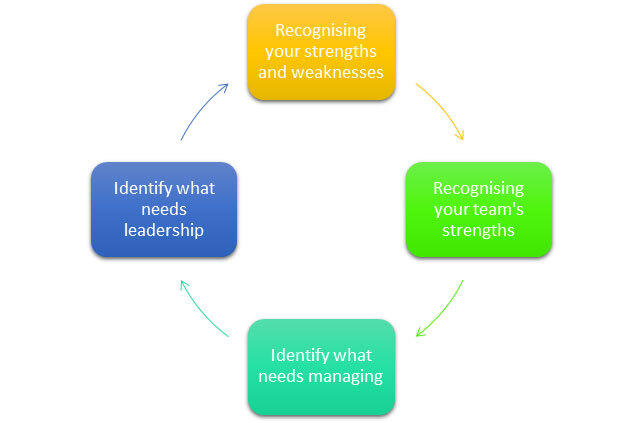
What people think they do and say could be completely different to how people see and hear them
To prompt positive behaviours from children with Autism we must support the child to build those behaviours.
This cannot be done unless a trusting relationship is made.
Making relationships with children on the spectrum may require you to think a bit differently. See the world from the child’s eyes so that you can experience it with them.
Strong relationships can be built when there is emphasis on the development of children’s play skills and their response and enjoyment to an educator’s emotions, feelings and tone of voice.
Educators need to be genuine in their interactions and be sure none over stimulate the child.
Really look to see what the child is seeing and what interests them by getting down to the child’s perspective and joining in their play.
When interacting it’s important to be attuned to a child’s state, motives and feelings. Educators do this by reading, acknowledging and responding sensitively to the child’s verbal and non-verbal cues that communicate, for example, an interest, a need, or an invitation to interact and play.

Teaching can be brought into every social exchange with children as long as you’re following a child’s lead and offering an exciting interaction. Children with Autism often learn better in small quick bursts.
Eventually social play will become fun and interesting because of your presence and the start of a rewarding, beautiful relationship can be built.
An educator worked with a child who was nonverbal, no eye contact, no communication, and many educators said “he has no interest and doesn’t show any play interest at all.” The child would walk around flapping their hands and when outside would crawl around on the floor exploring the ground and nature. He would eat things from the ground like sand and leaves during his explorations.
One-day the educator got down on the floor and crawled around and followed the child for over 20 minutes looking at what he was looking at, sharing quick eye contact and occasionally the child would become interested in the educator’s presence.
The educator soon discovered he was following the ants back to their home nest, crawling the same tracks as the ants. From that point the educator followed the ants. With prompting and lots of positive encouragement the child started to follow the educator and made eye contact. That was the “in” with the child. When we say “in” we mean finding the child’s strength and interest, just like the EYLF says.
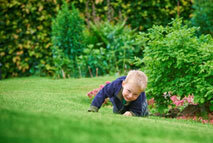
You can only enter their world by being a part of their world, and if you start by imitating the child’s behaviour to see what they are interested in, you might be surprised. From this point we are able to build a relationship.
Connecting first, communicating second bit by bit, the educators learnt what interested the child, and then extended on his learning by focusing on this interest.
Try and imitate what children get excited about, get down to see it from their perspective and try and understand what it is they are focusing on.
Step into the world of a child with Autism and see what they are seeing.
How many times do we try and control children in an environment that is not suited to their learning or interest.