
What do I do when children throw toys?

Throwing toys and fighting over a toy

Why are they throwing toys?

If it’s in the room and someone could get hurt, then that is no good. So, we need to redirect. For a quick fix get down with the children and show them how to build an enclosure for the toys i.e. look, these cars need a hoe, where can cars live, awesome idea, a car park, let’s build one. Or thee animals need to be kept safe, they look endangered, where can we keep our endangered animals s built, animals into farm enclosures.

Inappropriate Throwing can take time to plan an activity, for example

Once we moved outside Cade began to set up an activity for the children. “What are you doing Mr Cade?” Abby asked. “I am setting up a game to play Abby.” Cade told her. “But why?” Logan asked. “I thought we could use this game to practice our throwing skills. This game is to help us with throwing and turn taking rules. One at a time, you need to stand here and try to throw the ball through the tyre. Do you think you can do it?” “Yeah” the children all called out together.

Cade finished setting up the tyre and the game was on. Roman was the first to try. He threw the ball and it bounced off the tyre. “Great try Roman, you got it very close to the hole. Try again.” Cade praised his effort. Roman threw the ball a second time and it went straight through the middle of the tyre. “Yay I did it.” Roman cheered celebrating his achievement with the others. Before long all of the children had taken their turn. “You all did a fantastic job.” Cade praised them all.


Fighting over toys

Why are the children fighting over a toy, its good to get to know why and to do this get down to their level and ask. If you discover someone has grabbed it off another, then you teach the child to as if they could play with it, usually the answer is no, or if they could play together with the toy, which usually take time to sit with them and teach turn taking or you could re direct the toy grabber to another area or other toys.

What do I do when children do things to annoy me?

What happens when children are making annoying sounds?

A child is tapping on a table/window/surface that makes an annoying noise

Redirecting – Here is a musical instrument/ saucepan and wooden spoon. Let’s make music. If we tap on the window it may break.

Here is a great learning story that was developed because children were annoyingly tapping

Miss Tamara was telling Archies’ dad Jack that the group had a great interest in noise making which lead to seeing what we could tap on to make music. Jack said we have a guitar at home and Archie and I play it together all the time!!

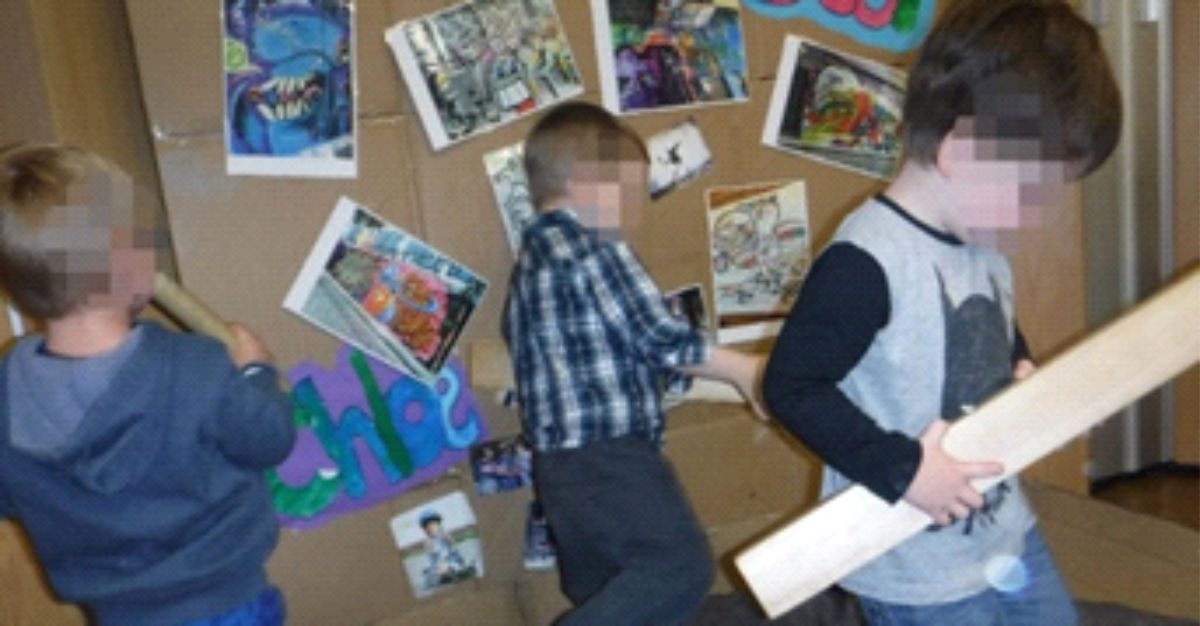
As an extension of noise making and Archie knowledge about guitars Archie, Charlie and Mason all made guitars out of blocks and rubber bands again. “Quick Tamara, come watch us!” Charlie began, “we’re going to put on a show just for you!” Charlie led Tamara to a chair and asked her to sit and watch them on the ‘stage’ (which is normally used as the skate park). The boys began strumming their guitars, humming along to the exact same tune with each other. Charlie even had a long round block to use as a microphone whilst they danced around the stage with big smiles on their faces. “We’re done!” Mason called as they stopped singing. Tamara began to clap, and then asked the boys if their new band had a name. “We’re the Bucking Bull Band!” Archie called.

The reason I want to show you how this annoying tapping was extending into learning and building guitars is because of the EYLF and literacy

The EYLF says “Literacy and numeracy capabilities are important aspects of communication and are vital for successful learning across the curriculum. Literacy incorporates a range of modes of communication including music, movement, dance, storytelling, visual arts, media and drama, as well as talking, listening, viewing, reading and writing.

Language is a system of symbols and patterns, and early literacy activities which involve music, movement, dance, storytelling, visual arts, drama and talking help children understand these symbols and patterns.

Participating in musical activities improves a child’s literacy skills as they learn to pick up the beats and rhythms of the music and language patterns.

Again, I want to show you how so many things we might consider inappropriate behavior is usually in the wrong location, or is a great opportunity to extend learning.

She has just drawn all over the wall…. AHHHHH

Drawing on the wall, again Creativity great, wrong canvas. What can we do?

Let’s draw on the paper or let’s draw on the path with chalk, but first let’s clean the wall together.


What do I do when children won’t listen to me?

Use your voice in interesting ways and children will listen

Your voice is an amazing tool that can help guide children’s behaviour and remember the loud voice is not always best.

The tone, volume and pitch of your voce can do wonderful things, what happens if you use a soft voice?

A loud voice?

A silly voice?

A crazy voice?

To learn how to use our voice to guide children and gain their attention, try playing Simon Says.

Playing Simon says type games allows educators to work out how to direct and give instructions to children and allows children to learn how to follow instructions from educators.

Simon says is best played with many different tones. Try it to see what works best:

“Simon says hands on knees

Simon says ahnds onnnnnnnnnnnnnnnn……….. head (soft voice)

Simon says

Practice using all types of tone, volume and pitch with silly crazy voices.

Andrew does not listen – what can I do?

“Andrew can you please get down from the table?” says Robyn.

What does Andrew really hear? If Andrew has a receptive language problem, he may only hear “Andrew table.”

You need to slow things down when children have receptive language problems. You may need to use pictures instead of words.

You need to take a deep breath in and work out what the child has actually understood. Communication is only as good as the response it gets.

Did Andrew do what you wanted? No. Therefore, what you are doing is not working. Change it.

Many educators are really bad at this. They just keep using the same communication strategy even though the child does not respond.

Remember, say things in a positive way.

“Andrew (leave time gap so they hear and process you are talking to them), feet on the floor Andrew.” (repeat name again at the end)

The following are simple little things we can do in practice.

I say ‘No’ and they continue doing it

How would you like it if you were yelled at across the room by your mother saying No, No No No. It wouldn’t feel good, and that is why we need to stop using the word No.

There are many ways can you replace the word NO

Imagine we are working away and a Child request something that can’t happen now. If we say no, and it’s a part of our everyday practice the child starts to give up and won’t even bother. So here are some great strategies to use instead of saying No

Can you read me a story please? Say Annabelle

Yes, I can, before I come over to read you the story look through all the pages to find your favourite picture.

Remember to look at all the pages and all the pictures. When I am finished with Jackson, we will look at the book together and I’ll read you the story. Or, if you want, you could come over here first and help me with the cleaning. Then we will can read a story later.

When we are transition from different spaces children may not want to cooperate with your request. For example, “I want to play on the fort” and you have just moved the children into the room for lunch. Great, you can play on the fort this afternoon, Let’s race to the door now: ready, steady, go. Let’s run!

You are just about to finish your shift and Eve says “I want to make a cake. Good idea. We can bake a cake on Wednesday once I can get everything we need. Can you ask your mum for some recipes when you are home tonight so we can get organized for Wednesday Cake Making Day?

I want to play for longer! Of course you can, five more minutes, one minute, thirty seconds, one more turn, any little amount of time to a child is better than saying ‘No’.

Eve is Angry and just ignores me

Sometimes we need to Break the negative mood with laughter.

As Laughter can be the best medicine

WE may need to Tickle children.

Chase children in a fun way with lots of laughs.

Make fun out of it. Shake loose a smile.

Be lighthearted and have some fun.

Put on the laughter music

Children get angry if you don’t listen to them, this is called stonewalling.

We need to assist children to express their feelings with time, empathy and support. Time means stopping and really listening to what children have to say, not just rushing through a room and saying “that’s nice dear” as we keep walking. When we listen, we are saying “I can hear you, I understand you.”

Ask questions

When children don’t listen to you, continually ask questions. When they answer the question they are showing you they know what to do ad are capable of doing it.

Educator: What do you have to do to serve morning tea?

Child: Get the trolly

Educator: What do you have to do before you get the trolly?

Child: Pack away

Educator: who could help you pack away?

Child: Ethan and Jack

Educator: Great, when Ethan and Jack have helped you pack away, what do you do next?

Child: Get everyone in to read a book

…..

Ask questions all day. Try it, it makes children think about time and the sequence of events.