Set up individual spaces that allow children to show their agency.

Agency is being able to make choices and decisions that influence outcomes. Children have agency when:

  • they make choices and decisions that affect them
  • take the lead in their learning and make choices about the design and outcome of the experience or activity

Children have a sense of agency when they imitate an action they have seen and discover that they can successfully repeat the action.

For example, educators at one service set up an art activity where children were invited to look at a bowl of fruit and create a painting in any format they wished. To help each child make their own decisions about the way they would paint their picture, the activity was set up so that one child at a time completed the painting. Each child individually decided how to approach the painting, where to start, which perspective to use, what textures and colours to use and how to compose the painting. They each painted what they each saw, understanding that no one else was there to tell them what to see or how to do it.

“Literacy is the capacity, confidence and disposition to use language in all its forms.” EYLF 2009

Here’s what Educator Penny said:

“Over the past weeks we have been exploring different forms of art and the process of art making and the meaning art can give. We have been looking at book illustrations and how they give meaning to the words of books.

To extend the concept of looking and creating artistic communication I intentionally added the process of ‘still life’. I combined “Biggest Morning Tea” and decided to incorporate a tea setting for the ‘still life’.

One concern of mine has been trying to eliminate the ‘same sameness’ when it comes to children participating in a similar artist or craft event. I was trying to think of ways to allow the children to see the same objects but create their own meaning.
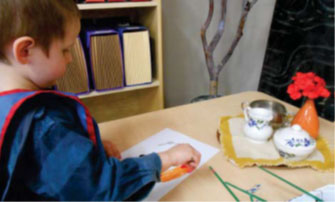
I decided to set the still life up as a single child process which I thought would remove the group creating the same output.

Each child sat and didn’t understand it was a painting exercise. When I asked them to look at the still life they looked through the objects and to the wall at a picture. I ensured no one else was there to tell them what see or how to do it.

I needed to say “what can you see?”

Once they identified what they saw I asked “can you paint what you see?” They were hesitant to start painting.

I changed the question to “Can you paint one thing at a time”?

What interested me was the children had such a clear idea and as soon as they said it they could see.

When I broke it down they were able to process the parts of the ‘still life’ and start painting. One child painted from an above.

Another painted the middle object first, then the side objects. For me this showed a great awareness of composition.

What do you see first  – “red flowers”  – so they painted from the back (red flowers) to the front.
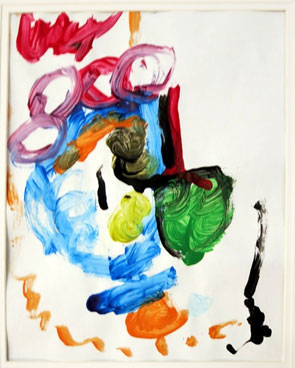
One child talked about the different texture, the wooden tray, and the cloth on top and the layers. He painted the representation of layers.
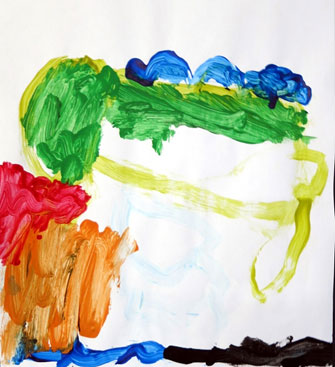
I limited the colours, but now reflecting after the experience this is something I will be investigating more as “there isn’t the right grey” said Dayman, where is the silver?”

“We haven’t got grey” I said. Dayman mixed the white with the black and made his silver. Dayman knew exactly what colours were needed to mix and achieve silver.
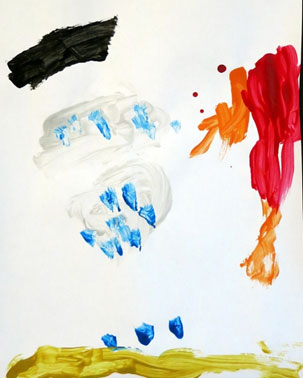
Peter painted the stripy artwork. I doubted his ability as he is a toddler. I was just about to brush him away and he did the red stripe last.

I pointed to the colour and he said “it’s the flowers”. As I pointed to another colour he said “blue pots.” The stroke of yellow was for the yellow fabric he said.

It amazed me how some children were accurate in their representation of the image of the pot.


It took me four years to paint like Raphael, but a lifetime to paint like a child. Pablo Picasso

I love how confident they are with their paintings. I was amazed how children can see three ways at once.  They could see it from the top, side and front all at once and confidently described and painted it.
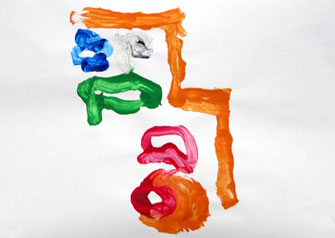
The biggest problem is us as I nearly shooed Peter away. I’m embarrassed to say it. I doubted him, but now I like his artwork the best.

I wonder what would happen if the children selected their own objects from home and created their own ‘still life’ painting. Does it need to be a painting? What other wonderful ways and techniques could represent the ‘still life’?”
Exploring agency to create calm

Children’s Agency creates calm

Children actively construct their own understandings and contribute to others’ learning. They recognise their agency and capacity to initiate and lead learning and their rights to participate in decisions that affect them, including their learning.

Sense of Agency

The EYLF explains agency is being able to make choices and decisions, to influence events and to have an impact on your world (EYLF page 45). A child with a sense of agency is someone who takes ownership of the thoughts, intentions and actions they generate. A child’s sense of agency is central to how they perceive experiences and their role within society.

The Guide to the National Quality Standards says assessors may look at how:

  • educators support play experiences initiated by children
  • educators allow children to direct their own play experiences with their peers
  • children begin to initiate negotiating and share behaviour
  • children show leadership, make decisions and follow directions given by other children

Agency can be a difficulut concept for educators. Below is an example of an educator’s discussion with an assessor explaining agency.

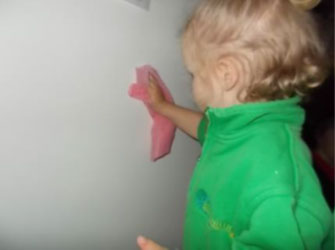
“We get excited when children make choices and celebrate their achievements. We have looked at ourselves and asked the questions, “do we do too much for children? Do we get in their way with our adult routine?” We see agency is aligned with identity and how they fit into the world. When you take parents’ perspectives into account, children do more then we expect they can and working with parents to promote their agency is great. For example, we have children taking control of their room by cleaning, setting up for lunch, setting their beds and running the room.

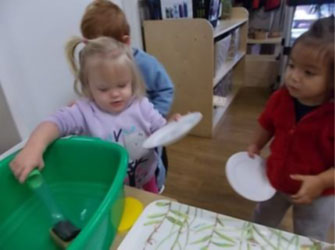
After morning tea the children washed their own plates, showing us just how much they enjoy taking responsibility and using the kinds of equipment they see grown-ups using all the time. They even waited patiently to have their turn. Olivia enjoyed the activity so much she got extra plates off the trolley to wash. Perhaps we could use her in the kitchen.

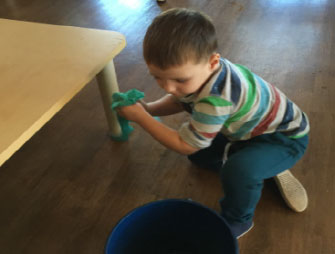
Friday means cleaning day so we used the opportunity to get the kids involved with the jobs. Skirting boards and chairs were all scrubbed. The children enjoyed the activity and it helps them to feel like they belong when they are given real responsibility as well as teaching them to care for their environment.”

How will you help enable children to have a sense of agency?


How do I create a calm environment?

Routines create calm environments

What is your room’s routine? Is it written down so all educators and older children have a daily reference. 

Does it include time for:

  • Planned physical activities
  • Routines which make transitions smooth and predictable for children
  • Routines which include spontaneous or intentional teaching to promote learning outcomes eg when we clean the tables we go round and round in a circle, let’s help our friends and pick up 3 blocks each
  • Planning with the children to ensure activities are based on their interests or weekend activities
  • Helper charts which are referred to and used during the day
  • Free play inside and outside
  • Talking with children about what they have learnt today and what they liked/didn’t like
  • Completing portfolio documentation with children (children talk and write, educators record and underwrite for young children)
  • Writing the program with the children
  • Packing up/cleaning with the children
  • Singing, dancing, dramatic/imaginary play
  • Looking after plants/animals
  • Small and large group activities
  • Several different learning activities to maintain children’s interest/engagement

If you don’t have a written room routine, try writing one in half hour or one hour blocks. Make sure you cover all of the activities above, then implement and refine after reflecting with colleagues. If you do have a clearly articulated routine, what areas can you improve? Reflect with other room educators and focus on at least one area.

We often find that routines are seen as parts of the day where things have to happen, but unfortunately learning is often not one of them. In these cases routines are adult directed with specific objectives in mind, so that learning can start again when they’re finished. Wouldn’t it be so much better if we used routines to promote learning outcomes? There is no set time or place for learning. It can happen anywhere and anytime, especially for children when so many activities and experiences are new.

Assistant Professor Caroline Fewster says the challenge is to design routines and transitions with children rather than for children, creating a sense of community. This supports children to become progressively independent, develop their knowledge and skills and become members of a group.

She says “..generally we ask children to pack away play materials as a group and sometimes only four or five children actually ‘pack away’. (This may) be unfair to a small number of children and create a lot of packing away for …educators. Instead of expecting all children in the group to pack away…, each child could have a more precise role…Children may work together to complete a task… they have chosen themselves. A democratic pedagogy would advocate giving choices to children…”

Choices could include things like:

  • designing the morning tea table in a small team
  • setting the table
  • folding paper napkins for meal/snack times in many different ways
  • setting out the beds together with staff
  • dusting shelves with a fun duster
  • feeding fish each day
  • listening to a small radio or going on-line for the weather forecast to be able to tell the group this important information
  • using small baskets to collect a few items from the floor
  • watering plants each day
  • recording rainfall in a rain gauge
  • feeding food scraps to animals
  • putting food scraps in compost
  • making play dough, selecting the colour and texture each week
  • packing bikes, balls etc away
  • planning sitting arrangements for group time – children can cut out pictures and match them to each child’s name, to give each child a place to sit in the group
  • photographing routines to provide visible cues for children about what is expected of them
  • creating a ‘Packing-up Message Box’ – with messages for children to guide the packing up system – photo messages can guide the actual task.

Source Fewster C (2010) Designing routines and transitions with children in early childhood settings.

Consider designing a routine roster with photos of the activities, then allocate names to the jobs after discussing with children.  eg

Checking weather forecast Names of children
Feeding animals
Watering plants
Making play dough
Packing up

How might designing routines with children increase their interest and co-operation?