
6.1.1 Engagement with the service

Families are supported from enrolment to be involved in the service and contribute to service decisions.

Look at the points below and see how many you incorporate at your centre, then hold a discussion about what you do well and where you could improve.

  • We invite and encourage families and children to visit and become familiar with the centre before they start
  • We encourage families to talk with educators about the values and expectations they hold in relation to their child’s time at the service before, during and after the enrolment process
  • We encourage families to share information about other child-related services accessed by the family (i.e. speech therapist, doctors etc)
  • We encourage families to stay with their child for as long as they choose during the settling-in period and on an ongoing basis
  • We encourage families to contact the service, and their child’s educator/s during the day if they wish
  • We assist families to develop and maintain a routine for saying goodbye to their child
  • We offer comfort and reassurance in a way that is suited to the child during separation from their family
  • We share honest information with families about how their child is settling into the service, and how the service identifies the individual education and care requirements of each child and their family
  • We describe to families how the settling-in process is tailored to meet their child’s need
  • We gather information from families to support continuity of care between home and the service
  • We learn about the family’s expertise, culture, values and beliefs and priorities for their child’s learning and wellbeing
  • We consistently support families to participate in the service, make meaningful contributions to the child’s room and centre.

List all the good things you do as a service when you enrol new children.

___________________________________________________

List the things you may need to improve.

___________________________________________________

Here is an example of a well written note and learning document for a parent, with the parent’s response at the end. This was displayed on Dubbo Early Learning Centre’s Nursery 2’s closed Facebook page.

Nice and safe! (Eliza)

This morning after Leo was delivered he was a little unsettled. Eliza sat down with Leo and gave him some cuddles. When Leo felt safe and secure Leo ventured off from Eliza’s lap to explore the environment in the Nursery yard. When Leo started to feel a little unsure about his surroundings he crawled back over to Eliza and communicated through non-verbal communication the need for some comfort (L.O 1.1) by placing his arms up in the air for a cuddle. Eliza responded sensitively to Leo’s signal (L.O 1.1) by giving him a cuddle. Leo ventured off again and crawled behind Eliza and climbed up the back of her shirt. Leo initiated a play experience (L.O 1.1) by tapping Eliza on her back then walking around to her side to give her a big smile then walking back. Leo did these steps several times. Eliza spent time interacting with Leo (L.O 1.1) while playing his little game.

Throughout the day Leo gained confidence as he ventured off by himself to see what is around Nursery 2. As Leo was crawling around he was sharing happiness and satisfaction (L.O 3.1) by sharing a big smile with his peers.

Parent response: Thank you SO much for taking such great care of Leo.

Exceeding theme 3: Practice is shaped by meaningful engagement with families and/or the community. The biggest influence on children’s lives comes from their family and community. When we understand more about the child’s family we can build a stronger relationship with the child and ensure they feel supported and included.

Home visits

Some centres implement home visits as a part of their enrolment process and to build relationships with parents and children.

Each visit takes 45-60 minutes and is carried out by two educators who have a set list of questions to ask. This ensures they find out about the child’s family, routines, favourite songs and activities. Some of the benefits include:

  • Helps new children settle on their first day because they have had an opportunity to meet and play in their own familiar space which makes transition from home to the centre much easier.
  • Improves relationships with parents
  • Educators get to know parents outside the service which allows parents to explain home routines and gives educators an opportunity to collect a wealth of information about their family
  • Educators engage with children in their own home which gives educators greater insight into the family and in turn makes it easier to create curriculum for the children

We discuss home visits more under Element 6.2.1. Try them. They work very well and will get you exceeding.

Exceeding theme 2: Practice is informed by critical reflection. The NQS Guide wants all educators to demonstrate self-awareness and be purposeful in the consideration of different perspectives that influence their pedagogy and the practice across the service. Critically reflect by looking through parents’ eyes. The element 6.1.1 says ‘Families are supported from enrolment to be involved in the service and contribute to service decisions.’

Think of yourself as a parent and look through their eyes. How would your enrolment process be for them?  Imagine the parent returning to work. How would it feel? Do you do enough for the parent to know how their child is? Does the parent know their child has friends? Keep asking other educators what their view would be if they were a parent. Remember, critical reflection is seeing from another perspective to see if your practice needs changing.

____________________________________________________________

Think of yourself as a relief educator that is in your room for a short time, perhaps for lunch covers. Is your enrolment process the best for them? Do they know the children’s names, likes, dislikes etc?

____________________________________________________

After this critical reflection what practice have you changed? This is what you need to show your assessor to get exceeding.

____________________________________________________

Exceeding theme 1: Practice is embedded in service operations – Let’s look at the last part of the element 6.1.1 Families are supported from enrolment to be involved in the service and contribute to service decisions.’ To do this we need the skills to build relationships through conversations. Below is a great ‘Greeting Parents Procedure’ that will build trust and in turn get families involved in the centre to ensure they are making decisions.

When a parent walks into the room in the morning educators must:

⦁ Make eye contact and say “Hi __________ (parent’s name)” and then “Hi__________ child’s name” by physically getting down and looking in the child’s eyes, then giving the child a big hug and welcome.

⦁ Start an informal conversation and ask things like:
(a) how the parent and child are
(b) whether the child had a good sleep
(c) is there anything we need to know eg medication that needs to be administered
(d) who will be collecting the child in the afternoon
(e) what they’ve been doing during the week (to get curriculum ideas)

Script
Educator: “How are you Nadine and Jackson? It’s good to see you today.”
Nadine (parent): “Hi Rachel – say hi Jackson.”
Educator: “Did Jackson have a good sleep?”
Nadine: “Yes, he slept all the way through.”
Educator: “That’s great Jackson. You will have lots of energy to have fun with your friends and learn lots of exciting things. Now Nadine, (use the parent’s name as many times as you can) is there anything we need to know like giving Jackson medication?”
Nadine: “No, all good.”
Educator: “What exciting things have you been doing on the weekend or over the week?”
Nadine: “Nan is visiting us from Townsville.”
Educator: “Wow Townsville is a long way away. We better explore this more today with our program.”
Educator: “Who will be picking up Jackson today?”
Nadine: “Daddy will.”
Educator: (look at Jackson and say) “That’s great Daddy will pick you up today. I’ll look after you and keep you safe until Daddy comes and picks you up. Give mum a big hug and say goodbye and we’ll put your bag in the locker and go and play.”
Nadine: “Thanks Rachel. Have a good day Jackson. I love you.”
Note: I will look after you and keep you safe until Daddy comes and picks you up. These words come from Dr Robyn Dolby’s research, and it works very well
3.2.3 Environmentally responsible

The service cares for the environment and supports children to become environmentally responsible.

The checklist below covers the basics of meeting the NQS Element. You need to be doing all of this or you may receive a working towards rating for this element. The most important part of the checklist is to ensure ALL EDUCATORS can do and show great practice plus they understand the element and can describe to other people and make them understand why you do things to meet the outcome of the element

In the case studies below, we look at examples of how educators have extended children’s knowledge about the environment and sustainable practices in ways that build on their interests and community connections.

Case Study – What is ‘drought’? (Tara)
To extend on from Lila’s interest in how the drought has affected our farmers the children learnt about what a drought means for their local community. Miss Tehanna provided access to the Smartboard (L/O 5.5) to watch a news report by Studio 10 about how the drought has impacted local farmers. We heard how local farmer Jason who is located on a property 100km west of Dubbo has been struggling with the drought.

Jason explained that he has invested $300,000 in his crop this year, but unfortunately has had 100% failure in crop growth. Jason explained that since there has been no rain, his crop was unable to grow, and he struggles to bring in income for his family to pay bills or buy food.

After we watched the report Miss Tara assessed the children’s knowledge by asking if they now had a better understanding of what a drought is and how it affects people, animals, plants and land (L/O 2.4).

Tom S. told us a drought is when “it doesn’t rain.” Damien added an important element of what makes up a drought saying, “it doesn’t rain for a really long time.” Damien also demonstrated understanding and knowledge of natural environments telling us “the water in the rivers comes from rain.” (L/O 2.4) Miss Tara replied, “that’s right Damien. If we remember our visit to NSW Water earlier in the year they told us how they measure how much water is in the dams and release the water when it’s needed.”

Oliver observed from the Studio 10 report that “the ground looks like sand because the rain’s not coming,” with Laura adding “it’s only sand and dead grass.” Thomas M. took note about how the lack of rain also affects livestock stating, “the animals die because they can’t have a drink.” Leo displayed a firm understanding of how the drought impacts financially upon the farming industry telling us “the farmer makes money from crops, but if there’s no rain there’s no crops and farmers get no money.” Miss Tara considered the nature of Leo’s connectedness to the land asking “can you tell me about your farm Leo and how the drought has impacted upon Pa-gee’s farm?” Leo told us “one of Pa-gee’s paddocks is dry, but Pa-gee is lucky he has lots of rain water tanks and there is lots of water in them. He has cows and sheep. They get lots of water to drink. The cow’s paddocks are dry, but the cows eat grass and hay. The sheep eat grain and lupins too.” Miss Tara thanked Leo for sharing all his amazing information and knowledge about farming saying “Leo thank you so much for telling us about Pa-gee’s farm. You know so much about farming! You have taught me so much.”

Next Miss Tara asked the children for their ideas on how we could help the farmers. Sophie M. suggested “give them water” and Sienna suggested “we can give them some hay and they can give it to their horses.” Miss Tara told the children that some of the ways we could help the farmers is through sustainability and saving water. Miss Tara explained that having a bath instead of a shower can help save lots of wasted water and asked the pre-schoolers if tonight they could do some “research” and when they have a shower keep the plug in the bath and see how quickly a bath fills up from the shower water.
Miss Tara asked the children for their ideas on how we can save water or some of the ways sustainability is embedded into daily routines here or at home. (L/O 2.4) Matthew said “we could use a pipe from the washing machine to the garden.” Thommo suggested that “if we don’t drink our water we can tip it on the plants.” Sienna extended on this idea saying, “or you can tip it on the grass.” Damien told us “we can turn the tap off. We turn the tap off at my home.” Stella L. followed on from Damien’s idea stating, “and we shouldn’t use the bubblers to get water for the sandpit.”

Miss Tehanna suggested “maybe we can write a list of rules for the bubblers?” Stella L. showed enthusiasm at this idea. Miss Tara asked for ideas on what the rules should be. Bronte suggested “bubbler is only for drinking water.” Lucinda suggested “don’t put sand in the bubblers so we don’t have to use lots of water to wash it all out,” and Stella L said, “don’t wash things up in the bubbler.” Miss Tara assisted Lucinda, Bronte and Stella L. in making a list of the Bubbler Rules by writing the 3 rules out for the girls to copy. Lucinda, Stella L and Bronte each wrote their rule onto the page and were excited to put blue tack on and place it outside above the bubblers.

Looking at the core of the exceeding theme for this element shows how Tara skilfully meets exceeding practice.

“All educators reflect upon the best ways to use the local community and families to identify ways to teach children about caring for the environment. This in turn sees children gain an interest in the environment and take their learning to implement with their peers, families and community.”

Case Study – Bees in the playground
Adrian and Nathaniel were curious about a bee they saw in the playground, so Cherie provided a range of resources that enabled Adrian, Nathaniel, and their friends Logan, Eva, Pippa, Issy B, Ivy and Chelsea to express meaning using visual arts (LO 5.3) and show their respect for the natural environment and the interdependence between people, plants, animals and the land.

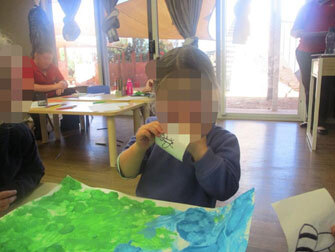
The children painted cardboard with blue and green then stuck on insects. The insects were drawn by the children and transferred to clear contact. The children stuck their insect onto the painted background. As the children chose their insect, Cherie told them a bit about that insect.

Pippa chose a bee. Cherie told her bees transfer pollen to fertilise flowers. Bees pollinate over 80% of all flowering plants. One in three bites of food that we eat is derived from plants pollinated by bees. After this spiel Cherie asked, “What do bees eat?” Pippa replied, “Eat flowers.” Cherie explained to the children the bee is one of the most important animals in the world by helping provide fruit and vegetables.

Cherie’s teaching showed the children how to become an advocate for a sustainable future and promote children’s understanding about their responsibility to care for the environment.

Next Cherie told the children about ladybird beetles. They mostly eat other small bugs, so they are carnivores. They are beneficial predators of plant pests. Ladybugs love to eat scale insects, mites, aphids and whiteflies. Cherie said “What do lady beetles eat?” Pippa responded “insects and flies.”

Cherie spoke a little about butterflies. They taste with their feet and live on a liquid diet. Adult butterflies have large often brightly coloured wings. Eva added “butterflies fly, and we can catch them.” Eva used feedback from Cherie to assist her own learning LO 4.4.

Cockroaches are pests worldwide. They lived on earth at the same time as dinosaurs. Cockroaches will eat anything from dead skin cells, garbage, people’s food and even faeces. Certain species of wasps eat cockroaches. When Cherie questioned what cockroaches eat, Chelsea replied “poo and food.” Cherie praised her for her answer.

Like cockroaches, ants are as old as dinosaurs. Most ants are either red or black in colour and like other insects have six legs. Cherie said, “What do ants eat?” Logan excitedly exclaimed “people food.” Cherie planned for time where Nathaniel and his friends could reflect on their learning and where they could see similarities and connections between existing and new learning. Cherie further questioned asking what colour ants usually are. Logan said “they’re red black.” Adrian added “they live with dinosaurs.”

There are over 100,000 species of flies. Flies like to eat manure and old garbage. They spread diseases. Cherie questioned what flies eat. Ivy replied “they eat my food. They fly like butterflies.”

The children started to learn some facts about insects and how they interact within the environment. Cherie exposed the children to new words like carnivore and predator. She explained the new words from a child’s perspective.

Excursion to Bunnings – Charlee
To extend upon the children’s interest in the insects we find in our garden, the important role they play and to build a connection between the early childhood setting and the local community (LO2.1), Charlee planned an excursion to our local Bunnings to buy some plants for our room and back yard to attract insects and birds.

After morning tea, the children put their shoes, vests and hats on then held onto the rope. ‘Do we know where we are going today?’ Charlee asked. ‘Shop!’ Ellie replied excitedly. ‘Yes we are Ellie! I want you all to help pick some plants for our room and yard’ Charlee explained. Toddler 2 then walked carefully to Bunnings and started to look for the items Mel had asked us to get for the centre. ‘Which colour should we get?’ Charlee asked as we came to the rakes.

Eva sought Chelsea’s involvement in making the decision (LO2.1). ‘Pink one’ Chelsea said laughing and Eva nodded quickly. Charlee and Emma then asked the children what type of plants they would like to have. ‘Spiky ones’ Kade replied. Molly and Charlee found some pointy succulents to match Kade’s suggestion.

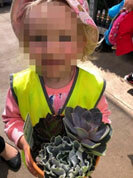
We continued to look around at all the plants Bunnings had while checking our list to see which ones would attract insects and birds. Then Miss Jade pointed out some blueberries. ‘What about some berries to plant with our strawberries?’ Jade suggested. ‘Yeah and the children can help us look after them’ Charlee continued. The children nodded their heads as Charlee grabbed a pot of blueberries.

This experience will help the educators provide the children with a range of natural materials from our environment (LO2.4) and also help the children to further understand multiple plants (LO2.4) we may find in our yards or gardens. Toddler 2 will embed sustainability into our daily routine and practices (LO2.4) through the care and nurturing of these plants and our gardens. Educators will allow the children to do most of the watering and caring to help them understand the impact of humans on our natural environment (LO2.4).

Case Study – Australian natives – (Kerrie)

Today Miss Kerrie drew attention to the relationship of the children’s local environment in their learning (LO 4:3) by providing native floral resources for the children to explore.

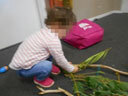
Toby, Zoe and Madeline engaged in their own learning (LO 4:3) by pulling apart the paperback, grevillea flowers and a salt bush.

Miss Kerrie talked to the children in a way that promoted learning about the paperback and how to take care of it in the environment (LO 2:4) by remarking, “Zoe, this tree is special as it has many uses to the human population.” Zoe was feeling the texture of the bark and looked at Miss Kerrie as Miss Kerrie responded, “The Aboriginals used the bark to carry their babies, to wrap food in before it was cooked and to make shelter for their families. They also used the flowers, which have a honey taste, for tea which is good for colds. That’s clever isn’t it?”” Zoe clapped her hands.

Madeline was curious about the environment, (LO – 4:1) taking a piece of salt bush and putting it in her mouth. Miss Kerrie remarked, “Do you like the taste. It isn’t that salty. Farmers plant this bush when the cattle have little to eat.” Del communicated non-verbally (LO 5:1) by smiling and taking another leaf off the bush to taste. Madeline then used the creative arts to express ideas and to make meaning (LO 5:3) by putting glue onto the bark and picking some salt bush and placing it on the bark. Miss Kerrie supported Madeline’s effort (LO 1:2) by asking, “Madeline what an artistic way to use the plants and flowers. Are you going to do anymore?” Madeline giggled before returning to her art work.

Toby used his sensory capability of touch (LO 3:2) to respond to the resources. Toby would feel the bark with his hands before putting them on his cheek. Miss Kerrie recognised and valued Toby’s involvement in learning (LO 4:1) by responding “Is it soft? Would you like to try another plant?” Toby communicated verbally (LO – 5:1) saying “No.” Miss Kerrie responded, “That’s ok Toby. The paperbark is really an unusual feel from most other tree barks. It’s a special tree in our local environment and that’s why we have to look after it.” Toby kept exploring pieces of the bark.


3.2.2 Resources support play-based learning

Resources, materials and equipment allow for multiple uses, are sufficient in number, and enable every child to engage in play-based learning.

The checklist below covers the basics of meeting the NQS Element. You need to be doing all of this or you may receive a working towards rating for this element. The most important part of the checklist is to ensure ALL EDUCATORS can do and show great practice plus they understand the element and can describe to other people and make them understand why you do things to meet the outcome of the element

The NQS wants us to design and create learning environments with resources that support ‘play based learning’ to encourage children to explore, solve problems, create and construct. Our job as an educator is to provide challenges for children by choosing equipment and materials that can be used in multiple ways, and allowing the indoor and outdoor learning environment to be regularly rearranged or adjusted with the help of children.

Case Study – Airplanes
During free play Miss Eliza and Thomas engaged in a game of travel using the toy airplanes to visit different destinations around the preschool room. This play session related back to Will’s visit to Tasmania he discussed on Tuesday. Thomas stated, “airplanes have tyres you know!” Miss Danielle carefully listened to Thomas’ attempt to expand on his thinking through conversing and questioning him “why?” “The tyres make the plane roll before it takes off” Thomas stated. It wasn’t long before the topic of airplanes became a group discussion where the children made connections between experiences they had with airplanes that related to the conversation.
“Airplanes work with an engine that helps them fly. I know because my mum said that” shared Leo. The children actively contributed to the group discussion about airplanes and explored ideas with one another as to how an airplane is built, how it operates and who works on the plane to ensure safe/enjoyable flights for passengers. “The plane has a driver and someone that helps the driver!” stated Laura. “The driver is called a pilot” added Tom. “There are passengers on the plane that need to go to school for 3 hours, so they go in the plane and see what’s in there. When they’re on there they can see planets like Jupiter and Saturn!” Jasmine told her friends.

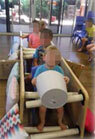
After researching information on the smart board, the children suggested we make our own airplane in the room and that we could fly to Big W. Miss Eliza and Miss Rhiannon challenged and assisted the children with building an airplane made solely with material and resources found in the room. This activity provided the children with a task that required investigating ideas through trial and error. Miss Eliza became involved with the children during this activity by following instructions to help construct the Preschool Room airplane. “The tables can be the walls and the chairs can be the seats!” suggested Will C. “We could use pillows as the tyres” said Oliver. “And then this bucket for the pilot to use to drive” said Thomas. Together the pre-schoolers resourced their own learning through connecting with one another to build the plane.

Learning new skills with natural material
Finley investigated a new idea today through play by learning how to weave with natural material. Miss Kerrie provided Finley with access to a range of plant material from the environment to assist her learning process. Finley engaged in the activity of weaving which required lots of hand and eye coordination as she learnt to place the branches over one string and under the other.

While Finley was busy weaving, Miss Kerrie modelled appreciation for the environment by saying “Finley, these are native plants which grow in our environment and don’t use a lot of water. Some of the plants are grevilleas, wattle, native jasmine and Miss Kerrie pruned them yesterday so that they would come back bigger next spring. Finley, this one is salt bush. See how the leaves are a different colour. This plant is one the cows eat in the drought.”
Miss Kerrie ensured that Finley experienced pride in achieving a new skill by responding “Finley, you have learnt this skill really quickly. Miss Kerrie is very proud of you. Did you enjoy it?” Finley acknowledged non-verbally by nodding her head.

Practice is shaped by meaningful engagement with families and community

The case study below shows us how to solve two problems. Firstly, the room has a group of busy boys that come four and five days a week. These boys get bored and don’t always like being in the room or centre. This has resulted in the room having ‘on the spot excursions’ to get them out and about before difficult behaviours occur. Secondly, see how the educator Rhiannon has skillfully weaved in the new exceeding theme 3 Engagement with families and communities. The service’s use and organisation of space and resources:

⦁ reflects the unique geographical, cultural and community context of the service
⦁ welcomes, respects and draws on the voices, priorities and strengths of the children and families at the service
⦁ engages in sustainable practices within the service and support environmental awareness and responsibility across the service community. Great work Rhiannon.

Case Study – Busy boys…
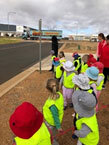
This morning Archie noticed that the Preschool children were not in their room. “Where did preschool go Miss Rhiannon?” asked Archie. “Preschool went on an excursion to a big school,” explained Miss Rhiannon. “Can we go on an excursion?” asked everyone excitedly at the same time. “Of course we can,” replied Miss Rhiannon. The children shared happiness and satisfaction as they put their vests on and found a place on the rope ready to leave. During our excursion we walked around the Business Park, having conversations about all the businesses and what we could see. As we walked past the smash repairers Patrick noticed there was an ambulance. “Look there’s an ambulance,” said Patrick. Miss Kerry explained, “the ambulance is over there so it can be fixed fast and work again.” “Yeah, the ambulance helps us get better when we’re sick,” replied Ava, exploring the connection between people in the community (LO 2.3).
The children noticed that there was some rubbish on the ground during our walk. “Why is there lots of rubbish on the ground? That’s not good for the animals,” said Ella. Miss Rhiannon discussed the ways the life and health of living things are interconnected (LO 2.4) as she explained, “that’s right Ella. If we put rubbish on the ground it will make the animals sick because they will eat it and it will make the grass sick as well and it won’t grow, and that’s why we have to put our rubbish in the bin.” This concept of where our rubbish goes will be explored further in the coming days.


3.2.1 Inclusive environment

Outdoor and indoor spaces are organised and adapted to support every child’s participation and to engage every child in quality experiences in both built and natural environments.

The Assessment and Rating process involves Assessors:
⦁ really looking at and referring to your QIP and asking many questions from it
⦁ using the NQS Guide’s description of exceeding to rate your service.
Let’s look at the exceeding themes that relate to this element in detail.

Exceeding theme 1 Practice is embedded in service operations
“Observed practice and discussions demonstrate a whole-of-service approach to the use of space and resources that is inclusive, purposeful, creative, and flexible, and enhances learning and development outcomes for all children.”

First, let’s explore the word inclusive. The Oxford Dictionary says,

‘Not excluding any section or any party involved in something.’

Research conducted by The Brotherhood of St Laurence and the Melbourne Institute in 2017 identified groups in Australia that experienced the highest rates of social exclusion:
⦁ Women are more likely to be excluded than men
⦁ Nearly 38% of people over 65 experience exclusion – more than any other age group
⦁ Social exclusion is more common among immigrants from non–English speaking countries than native-born Australians
⦁ Nearly 44% of Indigenous Australians experience social exclusion
⦁ More than half of Australians who have a disability or long-term health condition experience social exclusion
⦁ Early school leavers are much more likely to experience exclusion than those with a diploma or degree
⦁ More than 30% of single person and lone parent households experience social exclusion
⦁ Public housing tenants experience social exclusion at more than twice the rate of people living elsewhere.

We also need to think about how our language promotes exclusion or inclusion. When we deliberately avoid language that could be seen as excluding a particular social group we are being inclusive, for example avoiding the use of masculine pronouns to cover both men and women.
Sometimes we might use words that exclude people and groups. Here is an example of how an educator accidentally used a name that made a parent feel excluded. The good part of the story is that the relationships between the educators and parents are strong, which led to the parent messaging the centre.

“Hi! Just a little thing- to be respectful to Indigenous culture it is more accepted to use ‘Uluru’ as ‘Ayers Rock’ is ‘white man’s’ name for it. You do such fantastic stuff! Just thought I’d mention it as in your post for the room today you mention it a few times and also talk about respecting Indigenous culture so thought I’d mention it! Have a great arvo! Thanks for all you do!”

Hi Anne- thank you so much for reminding us. We value input from our parents and always aim to be respectful of our Indigenous culture. We are truly sorry for our mistake. I will make sure that it is corrected. We would love to have more feedback from you at any time. Thankyou Julie.

What words do we use or hear that could be exclusive?

__________________________________________________

Exceeding theme 3 Practice is shaped by meaningful engagement with families and/or the community

“The service’s use and organisation of space and resources:
⦁ reflects the unique geographical, cultural and community context of the service welcomes, respects and draws on the voices, priorities and strengths of the children and families at the service.”
“The service collaborates with family and/or community partners to:
⦁ foster an inclusive, welcoming and flexible play-based learning environment.”
How do you make sure each child’s and family’s voice and culture is reflected in your environment?

_____________________________________________________________

Exceeding theme 2 Practice is informed by critical reflection
All educators regularly reflect on opportunities to:
⦁ support every child’s participation and to further enhance children’s learning and development through the creative and flexible use of space, equipment and resources.

What do you see and hear if you look from a child’s perspective (critical reflection) and how is it different if that child is autistic, has cerebral palsy, cystic fibrosis or down syndrome? How could your words and perceptions feel to them?

Next we’re going to explore some common myths about these children and see how we could address the Element 3.2.1 to ensure we create inclusive space.

Myth Fact Spaces
Children with autism can’t feel emotions. Children with autism can feel lots of emotions, and often these are stronger than usual. However, they may only find it hard to express emotions, or only communicate how they’re feeling when they feel comfortable. Find out what makes each child with autism feel comfortable and adjust the environment eg consider colour, brightness, temperature, noise levels, textures, smell. Set up small spaces in the indoor and outdoor environment, and use these to help a child integrate into the group.
Children with autism can’t talk properly. Children with autism can have impaired language development. The degree of impairment can vary from minor to severe. Include lots of visual learning supports in all learning spaces eg put words with pictures, take photos of places and people, colour code routines and instructions, use body movements and different voice tones, tell a social story using child or their favourite character.
Myth Fact Spaces
Cerebral Palsy gets worse over time. Cerebral palsy does not get worse as people age, but the symptoms may become more noticeable eg their muscles may get stiffer. Treatments and strategies to manage the condition can help eg a child’s movements can be improved by practising motor skills. Include lots of gross and fine motor physical activities in play spaces, but remember child may tire easily. Source modified sporting equipment.
Myth Fact Spaces
Children with cerebral palsy can’t move around. Children with cerebral palsy are mobile. Some may use splints, sticks, wheelchairs etc to move around. They may have trouble making sense of information they see eg move around obstacles, judge size and shape of objects. Reflect on placement and type of equipment, furniture etc. Discuss layouts with children and families. Ensure access to activities etc is clear for children using walking frames etc. It may help to place activities on coloured place mats. Instal ramps, rails to rooms etc if required. Ensure child who need help to move are not left at same activity or location for more than 20 – 30 minutes.
Children with cerebral palsy can’t communicate. One in four children can’t communicate using speech because their mouth and tongue muscles are affected. But there are many ways to communicate eg sign language, communication boards and electronic devices. Make communication aids available in all play spaces, both indoor and outdoor.

Evaluate your practice compared to these examples.
What are you doing well? (Please write this into your QIP’s strengths)

__________________________________________________________

Where can you improve? (Please write this into your QIP’s improvement section)

_________________________________________________________

Myth Fact Spaces
Cystic fibrosis is contagious. A common symptom of cystic fibrosis is coughing, but you can’t catch the condition. It’s not contagious. Include learning about cystic fibrosis in the curriculum. Include children with condition in group learning and play activities in all environments.
Myth Fact Spaces
Children with down syndrome always feel happy. Children with down syndrome feel the same emotions everyone else does. They’re at higher risk of depression and anxiety than others. Take time to critically reflect through these children’s eyes. What is happening in their play spaces? What needs to change?
Children with down syndrome cannot take part in social and recreational activities. Children with down syndrome take part in sports, music, art programs and lots of other activities in the community. Ensure these children feel included and able to participate in all activities. Set up an edible garden. Children with autism may also like to touch, feel, taste different plants.

“The service’s approach to organising inclusive, play-based learning environments and to supporting environmental responsibility:

⦁ reflects robust debate, discussion, and opportunities for input by all educators, and is informed by critical reflection.”
Inclusion is about making sure each child feels included and able to participate. Read the following examples.

⦁ Educators may read a book to everyone at group time, but there may be children who do not feel comfortable sitting still for an extended period. They may, for example, have Autism or Sensory Processing Disorder. If there is no alternative to sitting and listening, for example acting out the story in the book, these children are not being included.

⦁ There may be a couple of quiet and private places children can escape to for some time alone or in small groups. If there are not enough of these spaces, or they’re not in both the indoor and outdoor environments, then there may be some children who are unable to participate because they haven’t had the time or space to ‘chill out’ and maybe focus on regulating their behaviour.

⦁ A service may have soft fall surfacing in most areas outside. This may not be a problem for many children, but for children with down syndrome, autism or sensory processing disorder, for example, who like to feel a lot of different textures, the absence of surfaces like bark, pebbles, rocks etc will mean they’re less likely to participate.

⦁ Children won’t feel included or able to participate if they don’t feel comfortable using the toilet and bathroom facilities. There may be privacy or hygiene issues, or the layout may mean that children with additional needs require extra help.

⦁ A child who’s seated at a different height to other children is less likely to feel included. They may be in a specialised chair for example, or a high chair. If it’s not possible to seat children at the same height, educators should consider other options, for example, painting standing or using special standing equipment, or lying on the floor to draw.

⦁ A child with additional needs may be reluctant to participate in physical activities and sports with other children unless their needs are accommodated in some way. For example, educators could make activities harder for able-bodied children eg replace running with skipping or enlarge the distance or area involved, or the team numbers can be altered.

⦁ It’s natural that educators give children with additional needs extra help, but if educators are always present the child may not have the chance to develop friendships with other children, or be accepted as a member of a group. This child will not feel included, and will be less willing to participate in group activities.

⦁ If educators know each child well, they’ll be aware of which children, for example, always sit at the front? They’ll also be reflecting on the other children? Why are they sitting at the back? Is it because they don’t feel included? If they changed position would they be more likely to participate?

Evaluate your practice compared to these examples.
What are you doing well? (Please write this into your QIP’s strengths)

_____________________________________________________________

Where can you improve? (Please write this into your QIP’s improvement section)

_____________________________________________________________


3.1.2 Upkeep

Premises, furniture and equipment are safe, clean and well maintained.

The checklist below covers the basics of meeting the NQS Element. You need to be doing all of this or you may receive a working towards rating for this element. The most important part of the checklist is to ensure ALL EDUCATORS can do and show great practice plus they understand the element and can describe to other people and make them understand why you do things to meet the outcome of the element

Case Study – Children maintaining safety and cleanliness

When you first look at this element it seems boring  – no more than a series of checklists to ensure the environment is safe and clean – but when you think outside the square and reflect on how you can involve the children in helping meet the element it can become exciting.

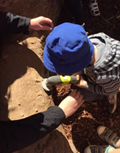
For example, a centre obtained a large part of a tree which was recently cut down by the local council and placed in their yard. As the months went on and natural decay occurred the bark started to peel from the log revealing very spiky nodules. These nodules cut children while they played on the log. Something needed to be done about it. Above is a child cutting off the spiky nodules under the guidance of the educator.

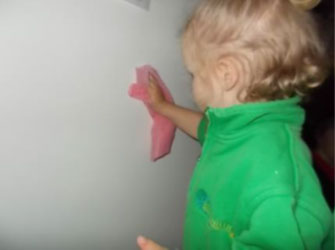
All cleaning should be completed with the children. One complaint I hear a lot is educators stating they don’t have enough time to do things. I say they’re not getting the children to help with what’s needed. The examples below are all from babies’ rooms, so please be inspired to get your children of all ages to help clean their learning environment and equipment.

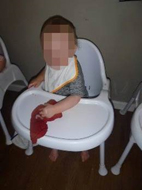
During afternoon tea, Toby began to clean his high chair with his washer before hopping out. Once everyone was finished eating, Cody (educator) asked Toby if he would like to help clean. Toby quickly walked over to grab a cloth. Toby showed his capabilities and independence cleaning, while Cody maintained high expectations by encouraging him to help. Toby made sure there were no stains or crumbs left and persisted until the tables were clean. Thanks for the help Toby.

The checklist below covers the basics of meeting the NQS Element. You need to be doing all of this or you may receive a working towards rating for this element. The most important part of the checklist is to ensure ALL EDUCATORS can do and show great practice plus they understand the element and can describe to other people and make them understand why you do things to meet the outcome of the element.

Friday means cleaning day so we used the opportunity to get the kids involved with the jobs.

Skirting boards and chairs were all scrubbed. The children enjoyed the activity and it helps them to feel like they belong when they’re given real responsibility. It also teaches them to care for their environment.

Washing Up

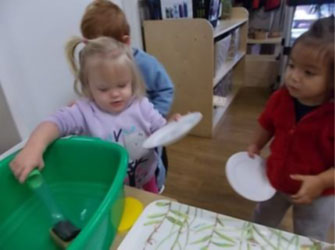
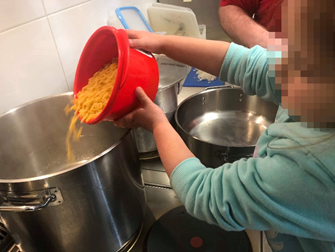
After morning tea the children washed their own plates, showing us just how much they enjoy taking responsibility and using the kinds of equipment they see grown-ups using all the time. They even waited patiently to have their turn. Olivia enjoyed the activity so much she got extra plates off the trolley to wash. Perhaps we could use her in the kitchen.

Children working in the kitchen with Chef Cade.

Looking at the core of the exceeding theme for this element shows how educators skilfully meet exceeding practice.

All educators ensure outdoor and indoor spaces, buildings, fixtures and fittings are safe, clean and well-maintained at all times. All educators reflect upon the best ways to include children, families and local community to assist in maintaining a safe and clean environment.

Exceeding theme 3: Families and community connection

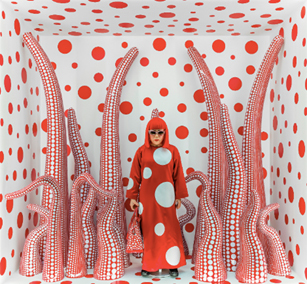
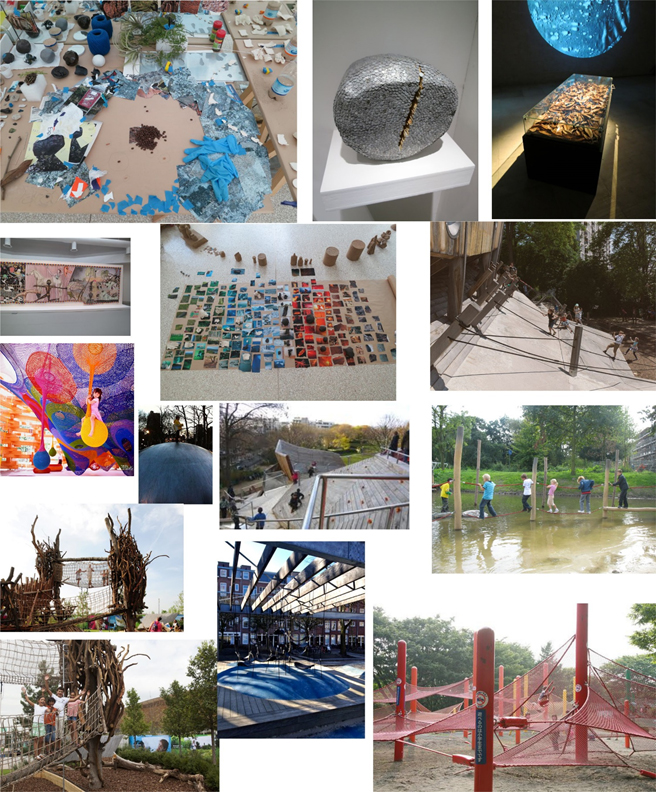
We can have a safe, clean and well maintained environment, but how do we give it that extra sparkle to ensure children are really attracted to it and want to play and learn in it? One way is to look outside early childhood settings at other places. The best places to start are museums and art galleries. For example, the Museum of Modern Art in Brisbane has had children’s exhibitions like Art Lab: Nature where children can ‘discover how artists and designers are inspired by the natural world in a new multisensory installation.’ Children are encouraged to ‘create a nature-inspired design, draw and arrange natural materials, and explore our nature discovery boxes.’

Don’t panic about budgets or think you need to create exactly what the museum has. I don’t. I want you to look at different ways others have enhanced their environment. It might be a little thing that inspires a change that you won’t find in any other early childhood centre. That’s what it’s all about. Being different, new and interesting gets exceeding. Being the same as everybody else gets you meeting.

Try looking up interesting artists like Yayoi Kusama Sandy Skoglund, Jee Young Lee, Ernesto Neto, Olafur Eliasson, Peter Kogler  Sebastian Masuda, Chiharu Shiota, Angela Glajcar, Trever Nicolas, Soo Sunny Park, Toshiko Horiuchi MacAdam,Choi Jeong Hwa, Richard Wentworth, Gabriel Dawe to see how they could enhance your learning environment.


3.1.1 Fit for purpose

Outdoor and indoor spaces, buildings, fixtures and fittings are suitable for their purpose

This NQS element is very exciting when we push the boundaries. I’m going to showcase Everton Park Child Care & Development Centre in Queensland, which was rated as Excellent.

Make children work for you. The aim of the element says ‘to support each child’s access to indoor and outdoor environments, services  should have sufficient space,equipment and facilities that are fit for purpose and promote children’s learning and development. Well-designed indoor and outdoor spaces:

  • are flexible
  • are welcoming and accessible
  • reflect the diversity within the local and broader communities
  • support the health and safety of children, service staff and families

including supporting the access of every child

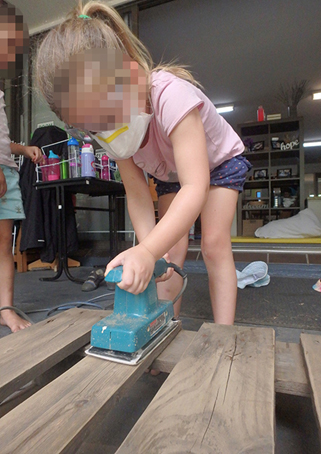
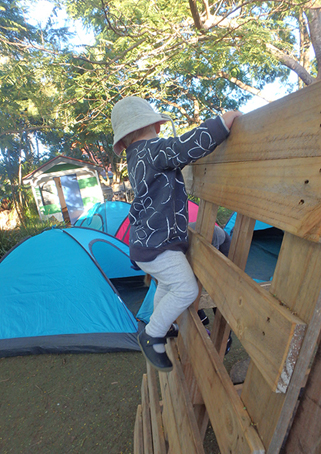
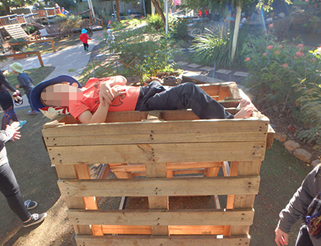
Now looking at the photos we can see boundaries pushed. For example health and safety is met as the girl is using a dust mask. The pallets allow for flexible uses, and as we can see with the young child climbing, they are accessible.

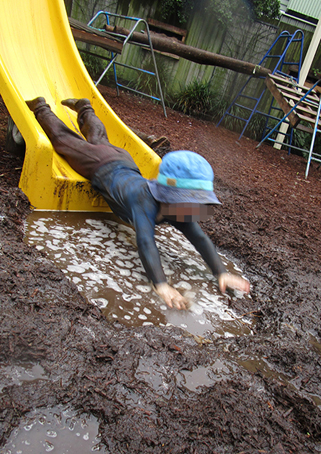
Again flexible use of material.

Above we can see how the service is promoting an understanding of and respect for the natural environment.

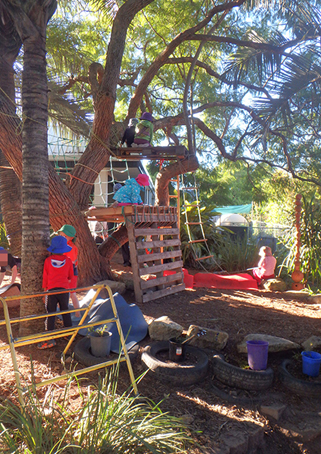
Climbing

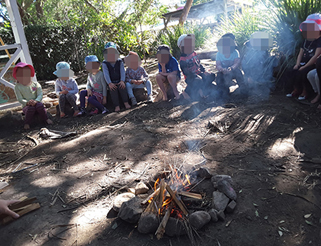
Yarning.

Exceeding theme 3: Practice is shaped by meaningful engagement with families and community

Create a mood board to display for families and seek their involvement in sourcing material. A mood board consists of images of ideas you like and want to explore further. The ideas can be radical or not directly related, but an aspect or feature that caught your eye.


2.2.3 Child Protection

Management, educators and staff are aware of their roles and responsibilities to identify and respond to every child at risk of abuse or neglect.

Go through the checklist and be honest so your Educational Leader and Nominated Supervisor know how to help you be the best.

E = Embedded, yes, I do that ALL the time.
K = We know we need to do that, but we don’t do
it all the time.
T = Please teach me how to do it or improve my understanding of why we need to do it.

Edu 1
Paperwork
Do you have a current Working With Children Clearance?
Planning
Do you tell your Room Leader /Nominated Supervisor when you think you need training in child protection?
Do you know there’s no need to prove that reportable conduct is occurring before reporting it?
Do you know you don’t need evidence of who’s abusing/neglecting a child before making a report?
Do you refer to the Child Protection Policy if unsure about a protection issue?
Interactions
Do you talk to team members and the Director about any child protection concerns you have?
Are you confident you know:
  • the indicators of abuse/neglect
  • the procedure for making a report of (suspected) abuse/neglect
  • mandatory reporting requirements
  • your Child Protection Policy
If the Director says they’ll make a report, do you follow up with them to ensure the report has been made?
Do you refer families to relevant support services (with their consent) when there are ‘lower level’ issues that are not reportable?
Best practice
Are visitors and students always supervised?
Do you try to have at least two adults present whenever a child is at the service?
Do you ensure a child is never taken into areas which can be locked or aren’t visible to others?
If the Director says they’ll make a report, do you follow up with them to ensure the report has been made?
Do you refer families to relevant support services (with their consent) when there are ‘lower level’ issues that are not reportable?

Definitions and Indicators of Abuse or Neglect
Indicators of Abuse

There are many indicators of child abuse and neglect. The following is a guide only. One indicator on its own may not imply abuse or neglect. Each indicator needs to be considered in the context of other indicators and the child’s circumstances.

General indicators of abuse and neglect

  • marked delay between injury and seeking medical assistance
  • history of injury
  • the child gives some indication that the injury did not occur as stated
  • the child tells you someone has hurt them
  • the child tells you about someone they know who has been hurt
  • someone (relative, friend, acquaintance, sibling) tells you that the child may have been abused

Indicators of Neglect in children

  • poor standard of hygiene leading to social isolation
  • scavenging or stealing food
  • extreme longing for adult affection
  • lacking a sense of genuine interaction with others
  • acute separation anxiety
  • self comforting behaviours, e.g. rocking, sucking
  • delay in development milestones
  • untreated physical problems

Indicators of Neglect in parents and caregivers

  • failure to provide adequate food, shelter, clothing, medical attention, hygiene or leaving the child inappropriately without supervision
  • inability to respond emotionally to the child
  • child abandonment
  • depriving or withholding physical contact
  • failure to provide psychological nurturing
  • treating one child differently to the others

Indicators of Physical Abuse in children

  • facial, head and neck bruising
  • lacerations and welts
  • explanations are not consistent with injury
  • bruising or marks that may show the shape of an object
  • bite marks or scratches
  • multiple injuries or bruises
  • ingestion of poisonous substances, alcohol or drugs
  • sprains, twists, dislocations
  • bone fractures
  • burns and scalds

Indicators of Physical Abuse in parents and caregivers

  • direct admissions from parents about fear of hurting their children
  • family history of violence
  • history of their own maltreatment as a child
  • repeated visits for medical assistance

Indicators of Emotional Abuse in children

  • feeling of worthlessness about them
  • inability to value others
  • lack of trust in people and expectations
  • extreme attention seeking behaviours
  • other behavioural disorders (disruptiveness, aggressiveness, bullying)

Indicators of Emotional Abuse in parents and caregivers

  • constant criticism, belittling, teasing of a child or ignoring or withholding praise and affection
  • excessive or unreasonable demands
  • persistent hostility, severe verbal abuse, rejection and scape-goating
  • belief that a particular child is bad or “evil”
  • using inappropriate physical or social isolation as punishment
  • exposure to domestic violence

Indicators of Sexual Abuse in children

  • they describe sexual acts
  • direct or indirect disclosures
  • age inappropriate behaviour and/or persistent sexual behaviour
  • self-destructive behaviour
  • regression in development achievements
  • child being in contact with a suspected or known perpetrator of sexual assault
  • bleeding from the vagina or anus
  • injuries such as tears to the genitalia

Indicators of Sexual Abuse in parents, caregivers of anyone else associated with the child

  • exposing the child to sexual behaviours of others
  • suspected of or charged with child sexual abuse
  • inappropriate jealousy regarding age appropriate development or independence from the family
  • coercing the child to engage in sexual behaviour with other children
  • verbal threats of sexual abuse
  • exposing the child to pornography

Indicators of Domestic Violence in children

  • show aggressive behaviour
  • develop phobias & insomnia
  • experience anxiety
  • show systems of depression
  • have diminished self esteem
  • demonstrate poor academic performance and problem solving skills
  • have reduced social competence skills including low levels of empathy
  • show emotional distress
  • have physical complaints

Case study – itchy bottom

Building relationships with children and families makes it easier to discuss difficult issues and to understand the context giving rise to the issue. Consider the following true story.

Educators at a service were concerned a four-year-old girl consistently had an itchy bottom and often had an unpleasant smell.

When educators asked her about washing at home, she said she didn’t have a bath because there was rubbish in it and she didn’t have showers either. Educators also suspected her clothes weren’t being washed.

What would you do? We need to have a child focus, which means we will start by asking ‘what is the effect of the abuse on the child’. The educators worked through their state’s reporting guidelines. The educators spoke with the Nominated Supervisor and decided to speak with the parents about the hygiene issues, stating that they may need to take the child to the doctor if her bottom worsened, and that it may be necessary to supervise the girl while she washed, which of course was necessary every day, to ensure adequate hygiene was being maintained.

The Nominated Supervisor and Room Leader asked if there was anything they could do to assist the parents.

The service then monitored the situation which thankfully improved. The parents’ working arrangements had impacted on the situation at home but improved when Mum changed jobs.

Parents may never know it was you who reported

“We live in a small country town where everyone knows everyone, and we are not afraid to report.

It’s the small things we notice and our gut feelings, then we go to the indicators and start documenting to build a picture. Once it started with a parent that stopped talking to us. It didn’t feel right, then the child started coming in the same underwear day after day. We reported and now this family receives assistance and the children are now cared for.” Nominated Supervisor

Our child protection system is based on the United Nations

Our child protection system is ‘child-centred’ in philosophy, consistent with the United Nations (UN) Convention on the Rights of Children (CRC).

The National Law says

Section 162A

The approved provider of an education and care service must ensure that each nominated supervisor and each person in day-to-day charge of the service has successfully completed the child protection training (if any) required by or under the law of this jurisdiction, a Government protocol applying to the approved provider in this jurisdiction or otherwise required by this jurisdiction.

National Regulations say
Regs 84 Awareness of child protection law

The approved provider of an education and care service must ensure that nominated supervisors and staff members at the service who work with children are advised of—

(a)  the existence and application of the current child protection law; and

(b)  any obligations that they may have under that law.

Reg 175 Prescribed information to be notified to Regulatory Authority

This Regulation changed on 1st October 2017. An approved provider must notify the regulatory authority of:

  • any incident where they reasonably believe that physical and/or sexual abuse of a child has occurred or is occurring while the child is being educated and cared for by the service
  • any allegation that sexual or physical abuse of a child has occurred or is occurring while the child is being educated and cared for by the service.

Exceeding Theme Core

All educators act on and can discuss their responsibilities under current child protection laws, regularly reflect on practices to support children’s safety and make identified changes, and actively raise awareness of child protection issues with families and community members in a culturally sensitive manner.

Where is your practice compared to the above statement?

___________________________________________________
___________________________________________________
___________________________________________________
___________________________________________________
___________________________________________________
___________________________________________________
___________________________________________________
___________________________________________________


4.2.1 Professional collaboration

Management, educators and staff work with mutual respect and collaboratively, and challenge and learn from each other, recognising each other’s strengths and skills.

We all have different strengths.

A key part of element 4.2.1 is to ensure we first discover then use everybody’s strengths. This will increase job satisfaction, improve practice and open the way for continual improvement across all areas.  This is especially important for young educators. When we stop and think about each educator’s values and strengths, we can carefully use them in ways that work best for them and for the team. Here are some examples.

Educators’ strengths How to help educators “shine” and improve overall practice How could we be accidentally shutting educators

down?

Cherie

Worked as a map maker (Cartographer) for 12 years at State Forestry

Get Cherie to create maps with children Not finding out what Cherie did before and not allowing her to use her past skills. Going on treasure hunts without Cherie.
Tina

Has a comprehensive knowledge of care giving to babies.

Support Tina to mentor other less knowledgeable educators to build their understandings and practices. Allow Tina to work in a room without babies.
Kate

Passion for environmental sustainability

Have Kate mentor other educators, create family and child awareness and action, and build an environmental / sustainability action plan for the service embedding education for sustainability in all aspects of service and teaching. Not using Kate to help recognise or understand the need for teaching and embedding sustainable practice, dismissing the importance of EYLF.
Cade

Methodical and detailed educator

Have Cade take on administration roles co-ordinating others to ensure compliance with all record keeping. Ignore Cade’s strength which could be a benefit for administration and recordkeeping.
Jemma

Interest in gardening and outdoor environments

Allow Jemma to oversee garden and outdoor environment projects teaching children and educators how to garden, plant, create outdoor learning environments. Not allowing Jemma to take on garden projects.

Employing a gardener.

Monica

Keen soccer player who participates in local league.

Encourage Monica to engage children in soccer games teaching children skills, concepts, promoting fundamental movements and active play. Ban team sports as they are too risky.
Mel

Leadership skills

Use Mel’s leadership skills to mentor and support less confident educators in leadership capacities, or to support educators in their role. Use Mel in a supporting role.

Case study – Educator’s strengths allowed to shine

Cherie was a cartographer (map maker) for 14 years before entering early childhood. See how she skilfully weaves her strengths and the community into learning.

Since going on our excursion past the smash repairers we have been studying cars. Ellie, Nella, Logan, Lucinda, Kyran, Jadzia, Charlotte and Nathaniel built a car park like the one at Big W. The children enjoyed gluing on the white markings showing where to park. Cherie provided opportunities for children to construct materials as a strategy for learning LO 4.4.

The children learnt we have designated spaces to park our car in. From their perspective as a car passenger they did not realise there are designated parks. Once the car park was constructed, we numbered the car parks and the cars from one to ten correspondingly on the park and on the car. This was to enable number matching. Cherie modelled mathematical language LO 4.2. Lucinda picked a blue car that was number 7 and Cherie asked her to find its parking place. Lucinda had no problems. Logan and Nathaniel enjoyed letting gravity run their cars down the ramp. Logan said, “this one going to shops.” Logan, Jadzia, Nathaniel and Lucinda confidently shared their learning and pleasure with others LO 4.4.

When they drove their cars up the ramp Cherie said, “Your car is going up to park.” Nathaniel replied, “down to the shops.” Cherie said, “that’s right in Dubbo. When you went to Sydney on the weekend to see your auntie, where did you park?”

Using strengths
Educators Eliza, Kerrie and Gabby believe professional collaboration starts by knowing each other’s strengths both as educators and personally. Through a guided reflective practice ‘Identifying Educators Strengths’ (30.10.18) it was established Eliza is great at leading educators and planning events for the centre to create a sense of belonging eg the “The Colour Run.” Kerrie loves and practices art outside the centre, which in turn sees her implement unique and creative ways to teach young children art (eg 5.10.19.) Gabby’s strengths include developing engaging lesson plans for the children (eg 4.10.19).

Communication
Critical and collaborative reflection amongst the educators has developed better communication. Quick morning meetings are held daily where the team set goals and plan how best to work together and with the children. For example, Nursery Two’s goals for the week were to find strategies to help Leo with room changes and transitions. Educators researched John Bowlby’s attachment theories, and reflected upon their own frustrations and how that may be affecting Leo. The team consistently questioned themselves to see how they were meeting Leo’s needs or what they might change to meet his needs. Educators also reflected through the parent’s perspective (2.11.18) and explored the tension Leo might be experiencing with his mother expecting a new baby.

Below is a case study that demonstrates all the exceeding themes.
The blue text is directly from the NQS Guide, page 222-223, showing exactly how Exceeding theme 1 Embedded, 2 Critical Reflection and 3 Meaningful engagement with families and communities and how it links into practice.

By creating a goal wall in our staff room to find out more interests and strengths of our educators, we discovered one of our educators has a love for all things science. Emma now works collaboratively to share her existing strength with the children and educators while continuing to develop her skills. She conducts daily science experiments with her children and shines as an educator! Through our wall our educators have begun consistently demonstrating a high level of collaboration, affirming, challenging, supporting and learning from each other.

Chemical Reactions! (Emma’s strength is conducting science experiments)
This afternoon Emma provided Eli, Olivia, Aria, Lucy, Brandon,  Heath, Hunter, and Natasha with resources that offered  challenge, intrigue and surprise, supported their investigation and enabled them to share their enjoyment while participating in a science experiment (L.O:4.2). As Emma engaged the children in the experiment, she explained to each child step by step how the experiment will work. Firstly, Emma encouraged the children to place four cups on the table and she placed some dry ingredients into the cups: salt, sugar, bicarbonate soda and baking powder.

She labelled them and explained to each child that they then had to place some liquid into the ice cube container: lemon juice, vinegar and water. She then explained, “I’m going to give you each a cup. You can choose one liquid and dry ingredient each and place them into your cup. We’ll see if it makes a chemical reaction.” Eli was the first to try the experiment. “Can I have this one?” asked Eli pointing to the sugar and lemon juice. “The salt has gone” said Olivia. Emma explained to Olivia and the others that the salt has dissolved into the water. “My turn please Emma” said Aria. As they were picking out their ingredients to place into the cups, Brandon, Nicholas and Natasha all used bicarbonate soda and vinegar and found out that it made bubbles.

“Look bubbles” said Nicholas. “It’s making funny sounds “said Brandon. “It’s fizzing” said Natasha. Xavier and Hunter used the equipment with increasing confidence and skills (L.O:3.2) when using the spoons to place the liquid into the dry ingredients. “LOOK I did it” replied Hunter. “Can I try?” asked Xavier as he used the spoon to try and pick up the water.


4.1.2 Continuity of staff

Management, educators and staff work with mutual respect and collaboratively, and challenge and learn from each other, recognising each other’s strengths and skills.

Preparing for next year – establishing continuity of care with educators

 If you want continuity of care you need teams that work together so they want to come to work and not go looking for other jobs. Below are some practices that assist in developing great teams that in turn create continuity of care.

  • All the policies and procedures need to be followed so there is consistency in practice and nobody is ‘making stuff ups.’ Most importantly, by following the policies and procedures educators know what to do and this knowing relieves stress from the job. When there is no stress good educators stay
  • All educators need to have input into their room, including the curriculum, displays, parent communication and room management. There would be nothing worse than going to work and always getting told what to do. When this happens educators leave
  • Team meetings are a great way for educators to bond, build teamwork and create continuity. This may occur outside the service
  • Mini meetings also encourage teamwork and continuity of care. Educators in rooms/ groups come together and have quick daily mini meetings to ensure everyone is on the same page. Mini meetings are a great way to clear the air quickly if there is a problem brewing among educators. We should always allow educators to work to their strengths
  • Match educators and room leaders that work well together and let them use their strengths. If they don’t work out move them to another room.

Meet Cherie – leads by example to get results

Cherie is a great leader. Some of her wonderful skills have come from bad experiences with her Room Leader in the past and Cherie never wanted to be like that.  Cherie says what makes a good Room Leader is allowing your educators to have freedom. For example Cherie says, “when I have Mondays off I often come back and the room is changed. I praise the educators and get them to explain why they changed it and ask what they want to achieve. I love hearing their ideas and get very excited for them. I’m always encouraging them to try new ideas, not just the room, but art experiences, new material, changing the playground. I feel that everyone needs to show their creativity at work.”

Case study – the way we introduce new educators and move educators into new rooms.

Last year a service had a complaint about the lack of communication when it came to moving educators into new rooms. The problem started when educators didn’t work well together, tensions where high and an educator needed to move rooms. This was not communicated to parents well and a complaint came in.

Solution
The service asked parents how they would like to be informed when staff move on. Nicky, the mum who had complained said, “we’re not stupid and we know that not all people are going to get along.”

Together the service worked out a better script to tell parents about what’s going on. These scripts are both spoken and placed on the closed Facebook pages for each room.


What can’t be said What we say to parents  
Educators struggling to work together, and the environment has soured, so we need to move educators around into different groups. We are re-grouping our teams to build on our educators’ strengths and ensure we provide the best for your child.

 Other ways to communicate to parents

When new educators start or are moved between groups, the service has a big campaign on the closed groups on Facebook and the open Facebook page. They introduce the educators to everyone and highlight their interest, strengths and passion when it comes to teaching. They invite the families to come up to the educators and introduce themselves.

Any positives comments about the educators from existing families or local community members are highlighted and boosted.

Below is a case study that demonstrates all the exceeding themes.
The blue text is directly linked to the NQS Guide, page 213-214, showing exactly how Exceeding theme 1 Embedded, 2 Critical Reflection and 3 Meaningful engagement with families and communities and how it links into practice.

Eleanor left our service in June 2018 and gave us 12 months’ notice before leaving. The Nominated Supervisor Mel worked with her to identify why she was leaving and what she wanted to achieve by leaving. Eleanor needed to leave to as her partner’s contract was ending in 12 months and he was to be moved to a new city in Queensland. However she also indicated she wanted to be placed in a leadership position. Eleanor reminded us nearly every month as a countdown that she was leaving on the set date. Discovering Eleanor’s ambitions led to her being placed in a shared room leaders’ role in the preschool room to assist with her CV and job prospects. She was also encouraged to start her ECT degree which she did as Queensland regulations requiring an extra ECT were coming in 2020 and this would improve her prospects of getting a job. Of course her ECT training also contributed to a high quality learning environment for children. When the time finally came to leave, the centre organised a week long celebration with a different event each day to celebrate her leaving. Please see the week of learning documentation and celebration for the leaving party. Eleanor used centre staff as referees and we were contacted by her new employer.