
Should educators be involved in children’s play?

Should educators be involved in children’s play?

EYLF and MTOP make it clear educators should be involved in children’s play – for example, being responsive allows educators to “enter children’s play .. stimulate their thinking and enrich their learning and “…educators take on many roles in play with children and use a range of strategies to support learning” p 15/p14.
A recent study looked at five different ways Australian educators are involved in play. Sometimes it’s about where educators are in relation to children, and sometimes it’s about educators’ actions:

  1. Educator positioned close to (eg sitting near) children
    eg during story time educator helps children to re-create story of Goldilocks and the three bears by prompting role play.
  2. Educator involved in play but seeks different outcomes to children
    eg children seated around a tub of water pretending to be pirates. There is a boat, some containers and a Lego pirate. The teacher introduces a block of ice and asks how the ice could be melted. Sam says the pirate’s hat is too big. The teacher smiles and returns to the problem of the melting ice. She is trying to teach scientific ideas – to “smuggle content knowledge into the play.” Learning from this rich, imaginary situation with the pirate was completely ignored by the teacher.
  3. Educator supervises children’s play but does not get involved
    eg Educator sets up and resources for play and then observes. Educator may quiz children about content of play, but does not follow up or become part of the imaginary play.
  4. Educator has sustained, shared conversations with children during play
    eg using the pirate example above, “what do you think it’s like to live like a pirate? Would you have lots of treasure? Where would that come from? How do you think people would have felt when the pirates took their treasure (empathy)? What’s it like sailing on the sea?” etc
  5. Educator is involved in children’s imaginary play
    eg Educator takes on role of a character in the children’s play (eg pirate).

Source: M Fleer 2015 Pedagogical positioning in play – teachers being inside and outside of children’s imaginary play

Reflect on which scenario(s) you think are the most common in ECEC services? What do you generally do? Now reflect on which scenario you think has the best outcomes for children.

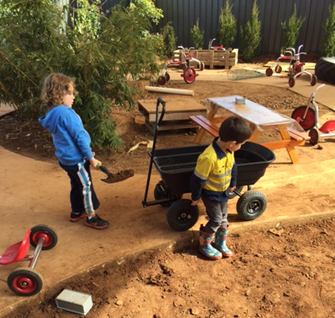
Views of play since late 1800s

Views of play since late 1800s

Late 1800s

Play was thought to be character building and to strengthen good moral character but children were not thought to learn anything eg Play is aimless and it gets rid of surplus energy (Spencer) 1873.

Early 1900s

Play allows a child to practice adult behaviours. Children are more interested in the process rather than the products of play. Play changes as the child develops (Groos) 1901.

Play used as a way to gain insights into a child’s phobia. Role play used to eliminate the phobia (Freud) 1909.

Mid 1900s

Each child goes through the same stages of development and play in the same order. Stages of play: sensorimotor stage with six sub-stages (birth to 2 years), preoperational/ symbolic stage (2–7 years). Play includes solitary, social, imaginary and object play (Piaget) 1962

This was implemented through Developmentally Appropriate Practice (DAP) where observations of young children were recorded and analysed in accordance with social, emotional, physical, cognitive and language domains – “ages and stages.”

Late 1900s

Frobel popularised the idea that the types of activities children engage in are crucial to their learning.  He developed kindergartens and toys/activities e.g. blocks, puzzles, construction kits, collage trolleys, child-sized home corner or dramatic area, child-sized tables and chairs, trestles and planks, slides, jumping mattresses.

Early 2000s

This period saw the emergence of EYLF and post-developmental theories of play. Play complexity is related primarily to children’s experiences and activities rather than their age.


Building with 4 year olds

Building with 4 year olds

It’s an exciting time when services decide to renovate their outdoor environments. At this point though, many services are concerned about the balance between safety and risk. There is an emphasis on protecting children from harm and hazards in the NQS and Regs, but did you know that there is also the requirement for services to provide “challenging elements of outdoor and indoor environments that allow for experiences that scaffold children’s learning and development and offer chances for appropriate risk taking?” NQS Guide 3.1.1 What is appropriate?

EYLF and MTOP also include risk taking as evidence of children’s progress towards learning outcomes eg

1.2 children take considered risk in their decision-making and cope with the unexpected

3.1 Children make choices, accept challenges, take considered risks,

4.2 Educators plan learning environments with appropriate levels of challenge where children are encouraged to take appropriate risks

Here Tyler and Darcy are removing the excess dirt from the area that will be the maze at Dubbo Early Learning. Ensure children are helping and working for you. In previous regulations we needed to give notice to the department before this type of activity and children were removed. What learning opportunities were our wonderful children missing out on?

Here Dale and Darcy are measuring the hole to see if it is deep enough for the post and concrete.

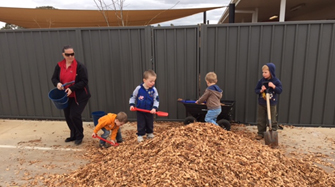
In this photo children are moving the bark chips from the car park to the new maze area.  This activity also includes lots of early numeracy learning. Below is the finished maze which was designed and constructed with the children.

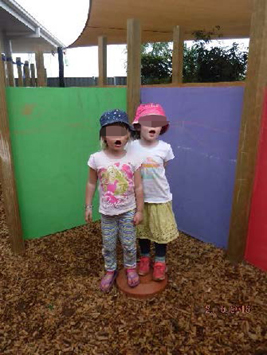
The maze provides a space to create very interesting dramatic play

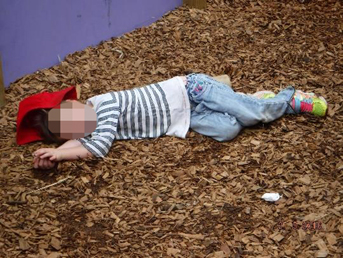
During outside play, Educator Brandi was walking around the playground and heard singing coming from the maze. As she approached the maze, there was Mia and Maddee (from Preschool.) She then found Ava and Jade both laying on the ground in different spots. She asked Ava and Jade why they were laying on the ground and they responded by telling Brandi that they had died during battle. Mia then told Brandi that she was singing because it was their funeral. The girls were very involved in their dramatic play.


Family camping trips create a learning environment that leads to calm

Family camping trips create a learning environment that leads to calm.

Samuel used the bark pieces in the outdoor environment to construct with, making them into one big pile. Mel the Educator asked Samuel “what is it?” Samuel said “fire”. Mel asked “like the fire you made with Daddy on your camping trip?” Samuel replied “yes” and nodded his head as he continued to build the fire.

Planning the environment on the spot

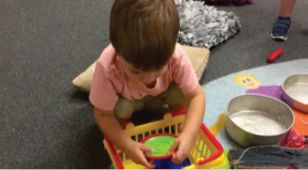
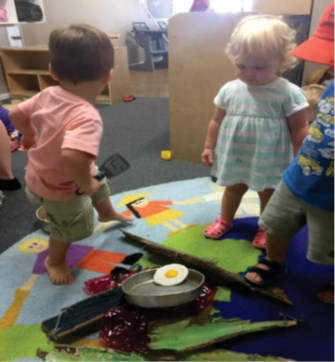
Mel the Educator extended on Samuel’s interest inside. Mel set up a campsite with pots, pan and a fire made from cellophane. Samuel was intrigued by this as he gathered around. Matt the Educator placed the pan onto the fire and asked Samuel “What can we cook?” Samuel replied “eggs.” Matt then asked him “where can we get the eggs?” Samuel walked over to the home corner, returning with an egg and placing it into the pan (demonstrating he was actively listening and understood what Matt had asked).

Samuel’s friends Archie, Harriet and Ignatius showed interest as they also began to gather items from the home corner and place them into the pan on the fire (actively contributing to the experience.) Matt then exclaimed “our food is ready.” Samuel walked back to the home corner where he grabbed the plates in a basket (demonstrating his understanding of sequence and order and what comes next.) Harriet & Archie enjoyed sharing   Samuel’s family culture as they were watching and learning. They continued to engage in pretend play freely recreating this camping experience.

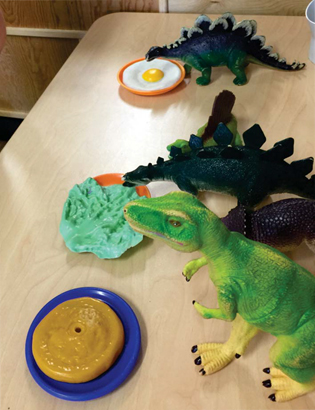
Samuel and Archie extended this play experience by moving over to where the dinosaurs were. They both placed the dinosaurs on the table where Matt was sitting. Samuel proceeded to transfer and adapt what they have learned from one context to another by getting the plates and food for the dinosaurs to eat.

Matt became the intentional teacher and planned on the spot by arranging the plates, food and dinosaurs in a sequence – three dinosaurs, three plates and three lots of food. Samuel handed Matt another dinosaur and Matt arranged it on the table and asked Samuel “What does this dinosaur need?” Immediately Samuel contributed constructively to mathematical argument by identifying the dinosaur was missing a plate and food and proceeded to get them for the fourth dinosaur.

See how planning the play environment occurs on the spot.


Building relationships with children and families to create calm

Building relationships with children and families can happen in many different ways. From here it becomes very easy to create learning environments.

Look below to see how a hairdressing salon was established. The parent sees the children’s interest in hairdressing and her hairdresser came in to give a lesson.

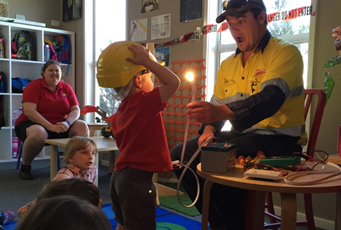
We heard of one service recently getting a dad who was an electrician to come in and do some work. While there he had a discussion with children about light bulbs and batteries, and children asked lots of questions about electricity and how things work.

A new baterry and light table was set up from this experience.

Do the children at your service love showing you what they can do? Are they proud when they set up their own play activities after deciding for themselves what they would like to do? These children are displaying their sense of agency. “I can do this.” At the same time educators are building trusting, respectful relationships with children as they encourage children to find their own voice and follow through on their ideas. “I believe in you.” “I have confidence in your abilities.”

It’s much easier for children and educators to do this when a service has inviting spaces for independent and collaborative play, when furniture and resources are appropriate for children’s development and interests, and when the layout of activities and resources takes into account a child’s perspective. “Can I reach that?” “Will I be interrupted?” “Is it too big?” “Can I play here with my friends?”

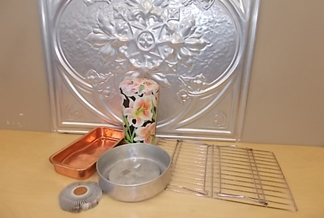
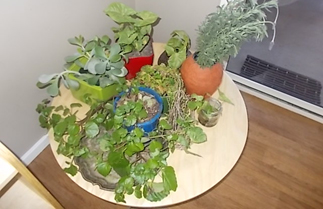
“We sorted the loose parts including kitchen bits and pieces and recycling and set up a focus table with all metal things on it. This was connected to Tom’s experiments with magnets which led to a lot of experimental play for everyone. In contrast to the table with metal, I moved our plants down from the high shelves and put them on a low table making sure to include lavender as a strong sensory experience. ” Penny, Brandi and Tamara

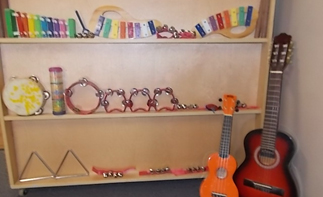
“I set the book shelf up as an instrument display and invitation for the children to play.” Penny

Do we as educators really listen to children’s comments about the settings and resources? Do we seek feedback from children and families about potential changes? Remember that to be “suitable for their purpose” buildings, spaces, furniture and resources don’t just have to ‘do their job’ eg be a space for quiet, restful activities. They have to encourage children to engage in activities which invite open ended interactions and promote learning outcomes eg explore, solve problems, create, construct.

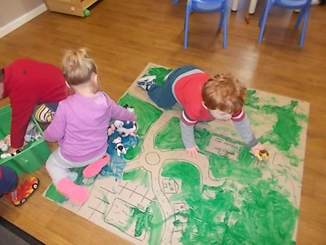
Tamara had the children turn our city road map into a country
farmscape instead using paint and adding toy animals. All this came from a desire to follow Angus’ interest and family culture as he lives on a farm.

How are children given the opportunity to plan and modify the outdoor and indoor environment at your service?

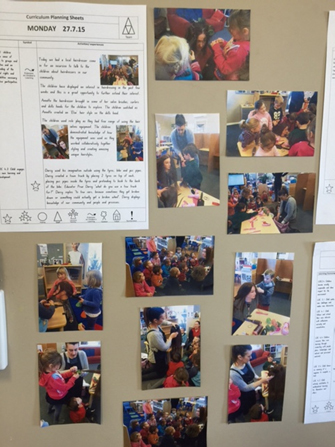
How do you encourage children to participate in their community? One way is to participate in local community festivals. Have a look below at how educators at Dubbo ELC actively encouraged children to be involved in the DREAM festival which celebrates the local creative community. There is a DREAM lantern parade where children can showcase lanterns they make along with those of professional artists. Lantern making workshops were held for school groups and the general public.  Dubbo ELC educators held their own lantern workshops. See the following extract from their Curriculum Planning Sheets.

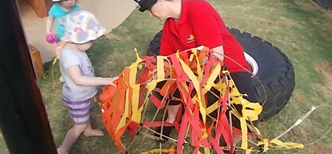
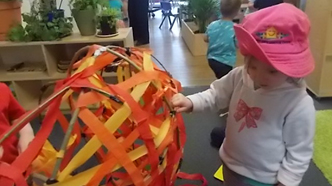
“Dubbo Dream festival has begun and to help join in the community spirit we have been making some lanterns this week. There will be twilight markets and a big lantern parade in town on Saturday night and I’m thinking some of the children will be there. We have made our lanterns in the shape of fish to continue our fishy theme. Logan, Stella C, Stella L, Chace, and Lilliana did lots of weaving in and out with crepe paper strips. Penny (educator) was impressed when Stella C called the strip of paper a streamer without any prompting. We tried to do some of our weaving outside and Alice and Georgia enjoyed the way the wind blew the streamer making it dance around in the air.

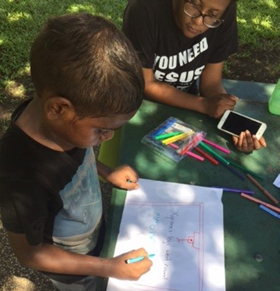
We continued making lanterns today. Alice, Georgia, Jasmine, Lincon, Lilliana, and Bell all worked very hard to decorate our paper lantern fish with textas. Jasmine tried using her left and right hands alternately. She concentrated hard and took special care to put the lid back on after using each one. Alice and Georgia named each colour as they picked it up.”

“Assessors may observe an environment that reflects the lives of children and families…and discuss how the service builds connections between the service and the local community..” NQS Guide 6.3.4

Does your local community hold a festival? How do you ensure children participate? If there is no local festival, have a look at what’s on in the broader community?


Create a calm environment with cardboard box

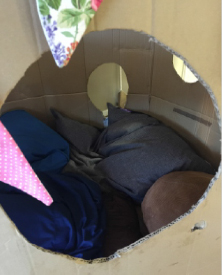
Penny creates a calm environment with cardboard boxes.

Banged heads and running inside solved with a large cardboard box.

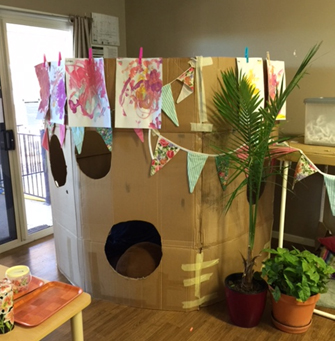
Penny the room leader of 18 month to 2 ½ year olds uses cardboard boxes from a big chain of stores. They even deliver the boxes to the centre. The cubby house has round windows which means the children are more careful when entering and exiting the cubby.

When the cushions are in the cubby the children are less rough. They can’t run and jump into them. We have less banged head accidents now.


Conversations to create calm

You should not be looking at the equipment and asking what activity you can do with it – and you should not be thinking about what activity you feel like doing today because it’s easy, not messy or you know another service that did it.

What do your children want to do? Ask them. What are they interested in? Talk to them and start conversations with their families. What is their life like at home? Find out information about their culture, siblings, extended family, pets, after school activities and use it to plan your curriculum.  With the babies and non-verbal children families are an especially important source of information. Surround the young babies with pictures from their life and they will show you what they are interested in.

Babies Example

“This morning while Jackson was happily sitting in the bean bag. I (Lesley) handed him a photo of one of the many dog pictures we have in the room. We have the dog pictures as families have pet dogs.  He looked at the photo for a bit. He was very intrigued with it. While he had the photo he started to smile and point as he was looking at it, and he couldn’t stop laughing. I gave him some of the other dog photos to look at and he was smiling and laughing at all of them. He displayed that he can explore relationships between living things as he was very happy to see the different dogs. This made me wonder what he does at home with his pet dog. Why does he find him so funny. Now I’m curious. I can’t wait to have a conversation with dad to discover more.

After conversation with dad …..To continue on with Jackson’s humour and love of dogs we have discovered his dog loves to play fetch with a ball. ‘Billy’ the dog retrieves the ball and drops it over to Jackson. Dad explained they continue throwing the ball and laughing for a long time.

To extend on our new knowledge about the game Jackson and Billy play we crawled around the floor pretending to be dogs and fetching the ball. We added many new words to our vocabulary – woof, run, fetch, retrieve, shake and bark.”

Toddlers

“Lilliana loves doing our exercises just like her mum. After each exercise we did she’d say ‘what’s next’ and would eagerly wait to be told. The children loved doing star jumps, jumping in and out. We did 10 star jumps today and counted each one. Tom and Oliver had so much fun they kept going until Tom counted to 15!

Faith watched her Uncle Jacob play cricket on the weekend. Faith also loves to play golf with her dad and even helps to pick up all the balls when they have finished. Faith loves all types of physical activity, just like her dad and uncle.

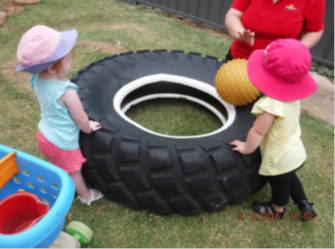
To extend on Faith’s interest in balls, we explored Faith, Alexis and Mia’s fascination with why the ball would continue to go around the rim of the tyre. Georgina explained to the girls that gravity along with motion helps to keep the ball going around and around the tyre. Georgina and the girls experimented by changing the speed they pushed the ball. If we went too fast the ball would go up and over the edge of the tyre. If the motion was too slow the ball would fall into the centre as there was not enough motion to keep it moving forward.”

Great work Rachel and Georgina, teaching children maths and physics at age two.

It has to be that easy. The more you know about how families live the more you are able to easily extend on children’s interests.

True Story by Matthew Stapleton

“Recently I helped a family day care mother. She has 3 boys aged 2, 5 and 7 living with her after they were removed from their family and community. The older boys have to leave school at 12 noon everyday due to their so- called behaviour issues. I went to the park with mum and the boys to teach mum some learning strategies. The 7 year old was illiterate. I followed his interest in climbing. He was amazing at it and I kept telling him how amazing he was. I taught him to count every step or every grasp along the monkey bars. I followed this by showing him Olympic gymnastics videos on my phone. He copied the moves perfectly. After he showed me his exciting skills I suggested we could write it up together. Within an hour and a half he was writing because he could see a purpose to it.

It concerns me that his school teachers find it easier to remove him from the school than in trying to find a way to engage him ie through following an interest. His teachers called this a behaviour problem, but none have stopped to listen to what he needs and wants. The most awful part of this experience was when he said “Thanks for learning me today.” He wants to learn, but is rejected at every turn. His comment made me very angry and appreciated at the same time.”

Do you have any children with behaviour issues at your service? How are you meeting their needs and wants?
How are you bringing their interests into the Curriculum?

When you have an understanding of children’s everyday lives, it’s easy to make connections to their community. Community is important. EYLF uses this word 67 times which is not surprising because the theory behind EYLF emphasises that learning comes from the connections children have with their community and families.

How do you make connections? Here are some ideas:

  • Go on excursions to places of interest eg a service recently visited their local Pet Barn store
  • Plan activities that relate to children’s after school activities, pets, parents’ jobs eg help children make an advertisement inviting others to the activity. Extend by making a newspaper with all the ads
  • Arrange guest speakers/presenters
  • Explore where activities/points of interest are on a map and extend numeracy and literacy skills at the same time
  • Set up a mailbox so children can write letters/address envelopes to local organisations
  • Arrange an exhibition of children’s art/craft at a local shopping centre
  • Find out what activities happened at children’s birthday parties – a definite source of interests
  • Get children to talk about their friends. Where do they see them?
  • What do children watch on TV/listen to?
  • What is their favourite food? Is there a reason this is a favourite eg they like going to a certain restaurant, their family is Indian/Chinese etc. Set up a ‘restaurant’ with the children

Once you start an activity, see where it can take you using the children’s cues and comments. This is how we extend learning. We have to be adaptable and flexible. That great idea we were going to do this afternoon may have to wait because the children are just so interested in continuing to explore what you’re doing right now.

For example, children at one service played with shells and sand after some visited the beach on the weekend. Educators extended this activity by helping children conduct some interesting experiments to see what sounds were made when children dropped things onto the shells. Did the size of something affect the sound? They talked about loud and soft sounds and high and low sounds.

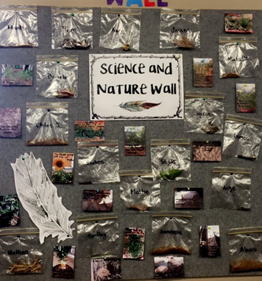
Do you include discussions about science and nature in everyday learning activities? How could you improve?

How do you ensure you listen and act on children’s views and ideas about learning activities?


What does the EYLF say about play?

Below are the ways  the EYLF uses the word play.

  1. PLAY & Learning
  2. EYLF has a specific emphasis on PLAY-based learning and recognises the importance of communication and language (including early literacy and numeracy) and social and emotional development
  3. PLAY-based learning: a context for learning through which children organise and make sense of their social worlds, as they engage actively with people, objects and representations
  4. PLAY allows for the expression of personality and uniqueness
  5. PLAY enhances dispositions such as curiosity and creativity
  6. PLAY enables children to make connections between prior experiences and new learning
  7. PLAY assists children to develop relationships and concepts
  8. PLAY stimulates a sense of wellbeing
  9. Partnerships also involve educators, families and support professionals working together to explore the learning potential in every day events, routines and PLAY so that children with additional needs are provided with daily opportunities to learn from active participation and engagement in these experiences in the home and in early childhood or specialist settings
  10. Educators plan and implement learning through PLAY
  11. Educators are also responsive to children’s ideas and PLAY, which form an important basis for curriculum decision-making
  12. Responsiveness enables educators to respectfully enter children’s PLAY and ongoing projects, stimulate their thinking and enrich their learning
  13. PLAY provides opportunities for children to learn as they discover, create, improvise and imagine
  14. When children PLAY with other children they create social groups, test out ideas, challenge each other’s thinking and build new understandings
  15. PLAY provides a supportive environment where children can ask questions, solve problems and engage in critical thinking. PLAY can expand children’s thinking and enhance their desire to know and to learn
  16. PLAY can promote positive dispositions towards learning
  17. Children’s immersion in their PLAY illustrates how PLAY enables them to simply enjoy being
  18. Early childhood educators take on many roles in PLAY with children and use a range of strategies to support learning
  19. They actively support the inclusion of all children in PLAY, help children to recognise when PLAY is unfair and offer constructive ways to build a caring, fair and inclusive learning community
  20. As children are developing their sense of identity, they explore different aspects of it (physical, social, emotional, spiritual, cognitive), through their PLAY and their relationships
  21. Children feel safe, secure, and supported
  22. Children confidently explore and engage with social and physical environments through relationships and PLAY
  23. Children initiate and join in PLAY
  24. Children explore aspects of identity through role PLAY
  25. Educators provide opportunities for children to engage independently with tasks and PLAY
  26. Children explore different identities and points of view in dramatic PLAY
  27. Children and Educators engage in and contribute to shared PLAY experiences
  28. Educators organise learning environments in ways that promote small group interactions and PLAY experiences
  29. Educators model explicit communication strategies to support children to initiate interactions and join in PLAY and social experiences in ways that sustain productive relationships with other children
  30. Children cooperate with others and negotiate roles and relationships in PLAY episodes and group experiences
  31. Children understand different ways of contributing through PLAY and projects
  32. Children are PLAYful and respond positively to others, reaching out for company and friendship
  33. Educators ensure that children have the skills to participate and contribute to group PLAY and projects
  34. Children use PLAY to investigate, project and explore new ideas
  35. Routines provide opportunities for children to learn about health and safety. Good nutrition is essential to healthy living and enables children to be active participants in PLAY
  36. Educators challenge and support children to engage in and persevere at tasks and PLAY
  37. Educators show enthusiasm for participating in physical PLAY and negotiate PLAY spaces to ensure the safety and wellbeing of themselves and others
  38. Educators draw on family and community experiences and expertise to include familiar games and physical activities in PLAY
  39. Educators use PLAY to investigate, imagine and explore ideas
  40. Children initiate and contribute to PLAY
  41. Educators join in children’s PLAY and model reasoning, predicting and reflecting processes and language
  42. Children use the processes of PLAY, reflection and investigation to solve problems
  43. Educators think carefully about how children are grouped for PLAY, considering possibilities for peer scaffolding
  44. Educators explore ideas and theories using imagination, creativity and PLAY
  45. Educators engage in enjoyable interactions with babies as they make and PLAY with sounds
  46. Educators use language and representations from PLAY, music and art to share and project meaning
  47. Children contribute their ideas and experiences in PLAY, small and large group discussions
  48. Children exchange ideas, feelings and understandings using language and representations in PLAY
  49. Educators engage in enjoyable interactions with babies as they make and PLAY with sounds
  50. Children exchange ideas, feelings and understandings using language and representations in PLAY
  51. Children take on roles of literacy and numeracy users in their PLAY
  52. Educators engage children in PLAY with words and sounds
  53. Educators join in children’s PLAY and engage children in conversations about the meanings of images and print
  54. Children use language and engage in PLAY to imagine and create roles, scripts and ideas
  55. Educators join in children’s PLAY and co-construct materials such as signs that extend the PLAY and enhance literacy learning
  56. Children use symbols in PLAY to represent and make meaning
  57. Children identify the uses of technologies in everyday life and use real or imaginary technologies as props in their PLAY
  58. Educators integrate technologies into children’s PLAY experiences and projects

Reflect on the ways the EYLF uses PLAY and how you are currently seeing PLAY in your centre.


Building a climbing frame with 4 year olds to create calm

Building with 4 year olds

An outdoor setting that promoted conflict and frustration was remodelled and renovated using design principles to create a structure and learning space for children to trial physical challenge and risk.

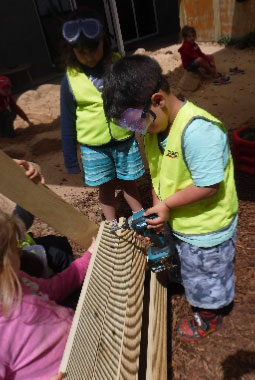
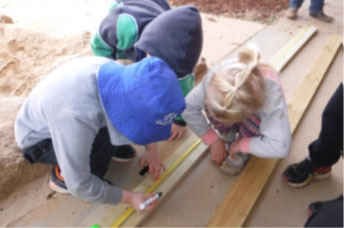
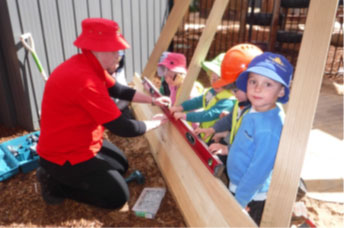
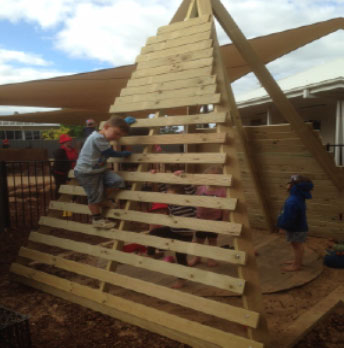
Extending on my design process involving the use of risk as a pedagogical element in babies’ and toddlers’ outdoor environment, a lead Educator in a regional NSW Long Day Care service together with her class of 4 year olds built a 5 metre high climbing tower.

Many concept designs were generated and refined.  Children evaluated the various designs demonstrating their agency, determining that a pyramid structure was the best design option.

The lead Educator had to overcome barriers to implement the design. Firstly, the Educator’s lack of knowledge about how to build this type of structure was overcome by incorporating families’ feedback and technical advice. This type of interaction strengthened partnerships with families and they donated the tools required to build the structure.

Secondly, other Educators had both a perceived fear about what children were capable of and the potential risks involved in building and playing on the structure, and a real fear about the lack of prescription in the National Early Childhood Education and Care Regulations. For example, Educators commented that the Regulations didn’t allow for such a high structure when in fact they contain no explicit detail about playground structures. Not surprisingly, building stopped when the lead Educator wasn’t present.

When building the structure, the children collaboratively learnt how to conceptualise, design, plan and construct. There were numerous opportunities to promote learning that engaged mathematical concepts including counting, measuring, sequencing, depth, size and angles.

Families were pleased to see their children involved in ‘real work’ with a significant outcome.

One parent said, “it’s about time they learnt real things” in relation to the building process.

With guidance from the lead Educator, the children developed the risk benefit analysis and then the rules children needed to follow when using the pyramid. Showing leadership they also taught the three year olds who shared the learning space these rules. For example, no more than two children can climb the structure at any time.

The structure’s height unexpectedly gave children the opportunity to view the immediate community. It expanded learning ‘beyond the fence’ which in turn has generated weekly excursions into the local community, for example to the hardware shop and the battery wholesalers. These excursions provide rich opportunities for Educators to extend learning and explore community protocols.

What started as a hands-on project to help children develop their physical skills and trial risk led to the opportunity of exploring the local community and expanding the learning environment beyond the service boundary.

The four year olds at the battery shop they could see over the fence.

When your environment has meaning to the children they will be naturally more engaged.


Creating a calm outside environment

Case study – creating a calm outside environment

Not all early childhood environments are purposely designed for the care and education of children. In this case study I explain how I solved the problem of inappropriate playground interactions by drawing on my design qualifications and existing research to implement the phenomenon of belonging in an outdoor environment through a new research design method.

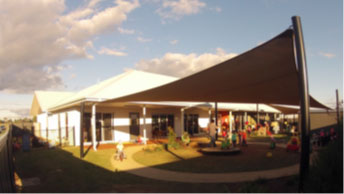
Below is the orignal space that was designed for 0-3year old children. The problem was it created lots of banged heads as children ran from one side to another.

The original outdoor playground was part of a new community/residential development in rural NSW. The developer’s interpretation of natural play space extended to a few trees on the fence line, a sand pit and grassed areas. This design resulted in a lot of conflict and frustration among the children and educators. Daily practice saw the equipment, usually simple climbing frames and bikes, removed from the shed and placed in the environment. At all times educators and children could clearly see the entire space and the play activities taking place. Children were not engaged in activities for long periods of time. They moved from one area to another continuously, and if a small group were engaged they were disturbed by the ever moving mob of other children. This was confirmed through interviews, video and photographic data along with an analysis of accident reports that indicated children’s ongoing movement around the space was contributing to a high incidence of injuries, often resulting from banged heads. Educators described their experience in the outdoor environment as exhausting and used the words ‘crowd control’ to highlight their actions.

The use of activity pockets

Activity pockets can be described as spaces that “surround public gathering places with pockets of activities – small, partly enclosed areas at the edges, which jut forward into the open space between the paths, and contain activities which make it natural for people to pause and get involved”. A mosaic of subculture is “an identifiable place and separate from other subcultures by boundary of nonresidential land. New ways of life can develop. People can choose the kind of subculture they wish to live in, and can still experience many ways of life different from their own. Since each environment fosters mutual support and a strong sense of shared values, individuals can grow.”

Final Designs

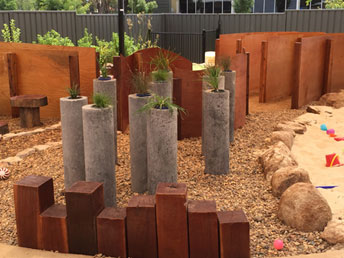
The final concepts produced a combination of eleven activity pockets and mosaics of subculture: 1) sandpit, 2) Concrete jungle,3) Three table area, 4) Circular area, 5) Tapering walls, 6) One table area, 7) Maze, 8) Creek Bed, 9) Tyre tower, 10) Mirrors, 11) Rock garden.

Children choose the activity pocket and subculture they wish to play in. With eleven activity pockets in which children are actively engaged, children are spread and segmented across the outdoor environment resolving the initial problem of injuries and unfocused play sessions.  Particular activity pockets are discussed below.

Activity Pockets 1-4: Sandpit, Concrete jungle, Three table area and Circular area

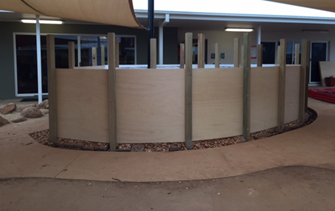
Four activity pockets are visible in the image above. I intentionally designed high walls so children couldn’t see across the playground, which in turned stopped the running, banged heads and limited play episodes. The small walls around the paths were strategically placed to ensure children had to stop and walk rather than run to enter a new area. The area’s surface comprises different materials to challenge young children’s locomotion skills. In this rural setting we don’t have great success with grass as a surface. There is not enough rainfall and the high traffic the surface experiences makes it too difficult to maintain. For this reason I re-conceptualised the grass into the concrete jungle structures next to the sand pit.

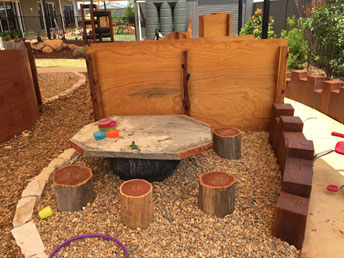
Activity Pocket 6 One Table area

Spaces for public gatherings include partly enclosed areas at the edge of the central path and clearly defined space which includes different ground textures of rocks, bark and compressed road base. The high walls stop children seeing across the yard and moving from one area to another. This encourages longer play episodes. The small wooden blocks create an entry by forming a mini wall where children need to walk around and gather at the table.  Educators use the table to create a subculture where new open ended material can be introduced or children resource their own learning by adding what they require.

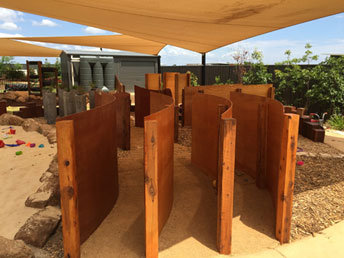
Activity Pocket 7 Maze

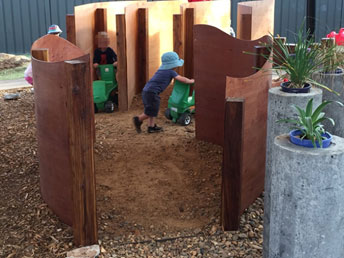
This activity pocket sees a space that doesn’t give a clear view to where you could be heading, with walls 1.2 metres tall. Many bikes have been stuck in these walls and educators often witness children using teamwork to solve this mathematical problem.

When designing this pocket I used the mosaic of subculture concept by drawing on Richard Serra’s minimalist sculptures. Serra’s work “A Matter of Time” can be found in the Guggenheim Museum in Bilbao Spain. My personal experience with his work inspired me to introduce his concept of ‘not knowing what’s around the corner’ and ‘feeling small’, and in doing so I wanted the children to “experience many ways of life different from their own.” In the old, open environment, children didn’t have any areas to explore. Because of these new spaces they can use their imagination to create new worlds.

Here a group are playing chase with their push carts through the maze. When the outdoor environment was complete the larger bikes became stuck in the maze area. The children solved this problem by requesting these smaller, green push carts. These play episodes have lasted more than forty minutes, even with a large number of children in the area.  At the time of this photo, for example, there were thirty-five children in this play area. As children dart through and interact in the maze, they create a strong sense of shared values.

Activity Pocket 9 Tyre Tower

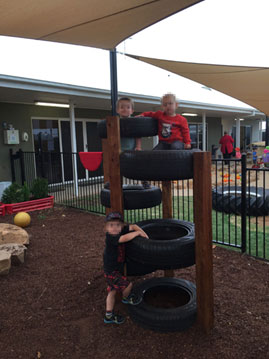
Using an existing, popular tyre tower design, I used risk as a pedagogical element in this activity pocket. The tower stands at two metres tall. As Little et al (2012) identified, children will only climb as high as they feel comfortable managing their own risk. Initial concerns from educators were raised regarding children failing as they thought the children would climb on the outside of the structure. To date, all children climb on the inside of the tower. Educators are trained not to encourage children to climb higher than they feel comfortable. Interestingly, when very young children enter the environment, the tyre tower is usually the first place they crawl to and pull themselves up on.

The tyre tower appears to have an unspoken membership among children. Observing children using the structure over time revealed an acceptance by the group when children make it to the top. For example, when the toddlers first entered the space the previously identified leaders of the group did not embark upon the climbing challenge whereas other members of the group happily engaged in the challenge. This altered the leadership structure of the group, both in the indoor and outdoor environments.
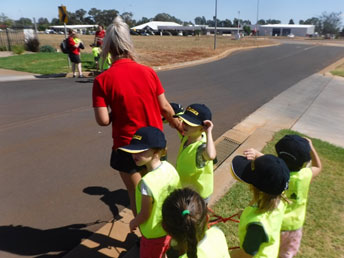
Activity Pocket 10 Mirror

Children form groups behind the mirror away from the view of adults. Adults are not needed as natural leaders appear among the children. On many occasions these play episodes last more than twenty minutes. The material used in the play episodes is usually rocks or other natural material.
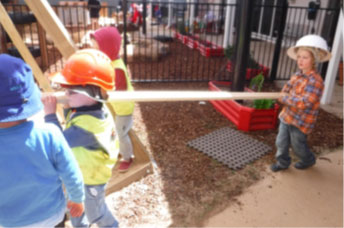
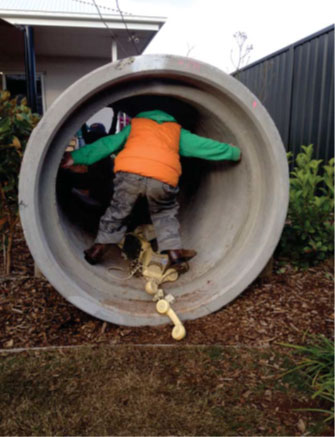
Conclusion

Comparing the outdoor space before and after the redesign reveals many different play practices and interactions. A design process which promotes children’s sense of belonging creates space for children’s engagement with the environment and each other.  This is evidenced by longer play episodes, blossoming friendships, reduced playground accidents, and richer and more meaningful play activities. Educators report, for example, that they are no longer required to control a crowd of children and are amazed at the length of time play occurs in different spaces using only the most basic of natural resources.